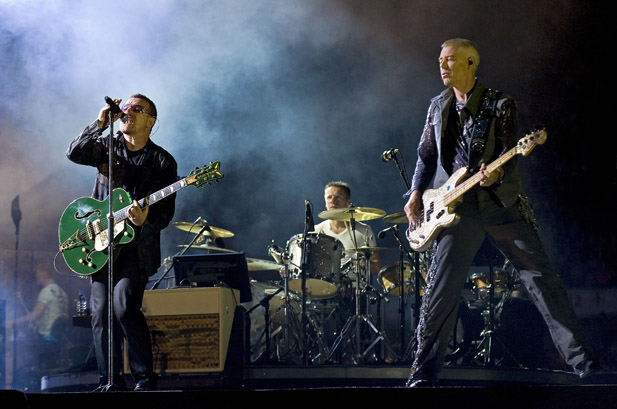
Global Horizons (Part III)

U2: Local Act, Global Horizons (Part III)  

By Justin Kavanagh | Tuesday, September 15, 2009  

U2 has reached a new generation of music lovers with its iPod and Blackberry campaigns — thus avoiding the fade into irrelevance usually suffered by aging rock stars. In the conclusion of his three-part series, Justin Kavanagh explores the performance art and marketing behind U2’s stage shows.

In the 1990s, U2’s stage sets embodied a new world order in which global consumers lived passively in 2-D.  Zoo TV was a mobile television station warning against the dangers of brainwashing by TV. Banks of screens subjected the audience to an onslaught of sensory overload with sound bites and advertising-speak. In the arena of marketing, U2 inverted the rules. The band received no payment for use of their 2004 single “Vertigo” in ads for Apple’s iPod.

 The 1997 PopMart extravaganza used an even larger wonderwall of imagery and illusion, crowned by a huge yellow arch to parody the age of mass consumerism.

The band embodied the parody, dressing as cyber-age Village People to stride cockily into the heart of another irony. They were the biggest band in the world — bigger now than Led Zeppelin — and they were caricaturing their own iconic stardom. Still, some in America assumed that the tour was sponsored by McDonald’s or Wal-Mart.

But if the medium was super-sized kitsch, the message remained uniquely subversive for a rock band. The Pop album asked aching questions about the absence of Jesus in the modern world. The lyrics had Bono “looking for to fill that God-shaped hole.” “Mofo” remains the darkest song in the U2 repertoire, a breathless scream for identity, for the love of a dead mother and ultimately for salvation of the soul. This was music and theater of the absurd so loaded with role-play and risk that it seemed bound to confound.

PopMart defied every cliché about rock ‘n roll by exposing its excesses under megawatt illumination. “Let’s go to the overground” was the band’s creed in the 1990s, a stance that challenged the standard rock star pose of embracing an illusory underground community. And yet, the band has stayed connected to worldwide audiences in a way that transcends the years and the sheer scale of these shows. At a 2005 concert in Chorzow, 70,000 Polish fans organized a massive mosaic flag in red and white for the early 1980s anthem “New Years Day.” The song was U2’s response to the communists’ brutal crackdown on the Solidarity trade union in December 1981.

“Mofo” remains the darkest song in the U2 repertoire, a breathless scream for identity, for the love of a dead mother and ultimately for salvation of the soul. The Poles’ act of flash-mob solidarity was organized by Internet and text messaging. This show of viral techno-savvy demonstrated U2’s success in attracting newer audiences and in connecting generations.

By the new millennium, the band had given their blessing to Apple’s iPod and the BlackBerry. In the arena of marketing, too, they inverted the rules. The band received no payment for use of their 2004 single “Vertigo” in ads for Apple’s iPod. Instead, they rode the popularity of the portable media player to bring their music to a new generation.  Likewise, the current single and tour have been widely previewed on U.S. TV and Internet ads for BlackBerry. Typically, the campaign inverts the standard artist/product endorsement routine — its tagline is “BlackBerry Loves U2.”

But if the band — or the brand — has charmed the world, their hometown often remains curmudgeonly in its begrudgery towards U2’s success. A 2006 decision to move part of its business to the Netherlands, in order to lessen its Irish tax burden, brought allegations of tax-dodging. Bono argued that Ireland has long sought to attract international investment in its financial services sector, but now cried foul when an Irish entity decided to make a similar investment abroad.

The Edge also defended the band’s global approach to finance. “[W]e do business all over the world, we pay taxes all over the world and we are totally tax compliant,” he said. But once again, it was Bono, as spokesman for the earth’s poor, who drew the real heat for what critics label as his hypocrisy.

If the band — or the brand — has charmed the world, their hometown often remains curmudgeonly in its begrudgery towards U2’s success.

Broach the topic in any Dublin pub these days, and you’ll soon hear a searing critique of the multi-millionaire behind the DATA and ONE campaigns. These initiatives aim, respectively, to combat poverty and HIV/AIDS in Africa, and to increase U.S. government funding for international aid programs.

Bono, if present, would defend his work for Third World debt- and hunger-relief on practical terms. He has been quoted as saying, “If you look into it, you think, ‘This guy works two-and-a-half days a week at this, not being paid for it, and at cost to his band and his family, and doesn’t mind taking a kicking.’” For all the local criticism, the band have always lived in Ireland, employed locally and invested in hotels, nightclubs and properties in Dublin. Their success has also driven the establishment of a thriving music industry. The city’s next big thing won’t want for local inspiration — and Dublin now appears on the back of most European Tour t-shirts.

The U.S. tour

In terms of spectacle, there now seems no limit to U2’s ambition. This year’s show takes place within what can only be described as a spaceship. How far can you take us, Bono? This is rock’s largest ever stage set: a 164-foot high, four-legged “claw” in centerfield. It gives stadium-goers from all sides open views of the band. A conical screen hovers above the stage. From this huge multimedia shrine, U2 will beam their gifts of sound and vision to the faithful. Onscreen, U2 will project to the masses their positive propaganda for a better world. In Europe this summer, crowds heard a message from Bishop Tutu and watched recent scenes of protest and repression from Iran. In place of the crank phone calls, Bono called up the captain of the space station to ask for the view from above… the state of the world through the eyes of God, perhaps?

At a 2005 concert in Chorzow, 70,000 Polish fans organized a massive mosaic flag in red and white for the early 1980s anthem “New Years Day.” And what of their music from outer space in 2009? Few bands of their vintage play anything but oldies on such tours, but U2 climb aboard their space-age magic carpet to explore new boundaries. They will open with four songs from the new album, No Line on the Horizon.

The encore promises to reveal a band that still treasures “vision over visibility,” in the words of their most visible frontman. U2 will invert Oscar Wilde’s famous artistic creed about living in the gutter but looking at the stars. In the new song “Moment of Surrender,” Bono takes a crawl through the gutter in the persona of an alcoholic confessing his sins.

Despite the “War of the Worlds” spaceship stage, it is the band’s ability to relate to a crowd on a human level that still makes a U2 concert an extraordinary experience.

In Washington this week, the song “Walk On” will bear witness to the courage of Aung San Suu Kyi. It will shine a light onto the mendacity of her incarcerators in Myanmar. A line of local volunteers will walk onstage, each wearing a mask with the face of the incarcerated Burmese opposition leader.

“Walk On” echoes one of the world’s great soccer anthems, “You’ll Never Walk Alone.” Its message of hope for finding one’s way home in the world resonates with every crowd. It’s a simple human message, best delivered in person by fellow-travelers. Wherever you are in this world, you’re not alone…Walk On.

Spaceships may offer us the view from the gods, but at ground level it is local acts that lead to global change.  And when the 49-year-old Bono walks onto his spaceship stage this September, I’ll think of the young singer from Dublin asking all those years ago, “Have yous far to go?”

Editor’s Note: This is the conclusion of a three-part series on U2. Read Part II here.

Just feeling U2's next show

Monday night the band all rested up from two days in Chicago, opening the North American tour they head off to Toronto for a show on 9 /17. They have switched planes at this point a retro fitted Air Canada Airbus A320-211 C-GQCA (msn 210) in the colors of the Irish rock band U2 with “ThreeSixtyAir” titles.

The tour is in support of the group’s 2009 album “No Line on the Horizon”.The U2 360° Tour is named after the 360-degree staging and audience configuration it uses for shows, which U2 claims is “the first time a band has toured in stadiums with such a unique and original structure.” Previously AC decorated A320 C-FPWE for the U2 Vertigo Tour.

Twitter: We have had some fans ask us who else they can follow via twtter for show updates and news. We have tons of references the best way would be to see who follows us and start following them.  The whole idea for U2TOURFANS was to create a place to exchange the fan experience. We really don’t mind sharing the tweets or the information. In fact it makes the experience that much better.

1000MIKES: Yes you asked and we do have channel we will offer the use of the channel to a different fan for each show. Yes we plan on using it as well. However we all know how long batteries last. We of course use a Blackberry Bold *AT&T and LG ZEON

YouTube: Our channel of course can be found via U2TOURFANS we try to post videos within 48hrs of the show, however that does depend on many factors ( too boring to talk about)

 Chicago Show: Mixed feelings. I guess the highlight was Blue Room.It debuted live during the main set, 14 years later. Fact: This ws the only second Passengers song that U2 has ever played live.

 The Process:  We have been working on a couple of stories. Bottomline it comes down to time and interest. We take your feedback and we look for the story. Most of you have asked for the tour news, such as how many trucks, how do they tour the US ( bus, plane ) All of those details. One item everyone has been asking for we have not choosen to share. “Techincal Rider” this is really something that should remain with the Band and the venue. 

Review Chicago Sunday

Bono singing ’Chicago’ in the introduction to Magnificent, with the audience, unsurprisingly, in seventh heaven. ’One for the money, two for the show, where are we in the world… Union Street.’

The second show a chance to win over the Chicago news. The band was rehearsing “Your Blue Room” earlier in the day and they did not disapoint. For Your Blue Room, widely agreed to be among the most beautiful tracks the band have ever written, released on the 1995 album Original Soundtracks when the band recorded as Passengers with Brian Eno


It debuted live during the main set, 14 years later.

Fact: This was the only second Passengers song that U2 has ever played live. Adam did not have his spoken verse rather it as done by te astronauts (International Space Station) pre-recorded from the first show.

Couple of points

  • During “One” a few of the vocals, missing
  • Elevation was mixed into a couple of songs
  • Unknown Caller was incomplete, mixed in a some of Breathe

The band had some other changes, most of the tweeter comments said while the flow was different it fe

lt little like a start and stop. This joint was jumping for Elevation, while Until The End of the World and Stay, another couple of songs which have been played sparingly to date, also had 65,000 people lost in the music. ’Green light, Seven Eleven/ You stop in for a pack of cigarettes/ You don’t smoke, don’t even want to/ Hey now, check your change….’ And if the suit of lights for Ultraviolet is making a name for itself, welcome to the steering wheel microphone swinging low from high up in space station - now with added LED’s.

Most will agree its an amazing show. Song selection is key we wonder what you thought ?

Videos posted on U2TOURFANS channel - Credits to twitter followers, and wide news release.

U2: Local Act, Global Horizons (Part II)

The Globalist, September 11, 2009
By: Justin Kavanagh

U2TOURFANS Editor Note: This is a long story, read all the way to the end. Its broken into three parts.

Since their beginnings in the troubled Dublin of the 1980s, U2’s political message has stayed strong. From speaking out about Pinochet’s crimes in Argentina to working in Ethiopian refugee camps, Justin Kavanagh explains how singer Bono has kept up his activism while evolving with the times.

From the start, U2’s songwriting confronted the problems of the world. Few bands have drawn inspiration from such a global diversity of subjects: from Hiroshima’s holocaust (“The Unforgettable Fire”) to Martin Luther King (“Pride (in the Name of Love)”) to third-world hunger (“Crumbs from Your Table”).

U2’s music challenged listeners to hear nuance beyond the catchy choruses. Their debut album Boy hinted at an idealistic belief in the power of the imagination to shape a better world. Bono sings, “I thought the world could go far/ if they listened to what I said.”

Critics consistently pointed out the paradox of rich rock stars acting as spokesmen for the downtrodden. Years later, when Bono met Horst Kohler — then head of the IMF, and now the President of Germany — the politician challenged him directly, saying, “So you’re a rock star. You make a lot of money and then find a conscience?”

In fairness, the singer had earned the right to rage. He wrote “Where the Streets Have No Name” after he and wife Ali spent time as volunteers in an Ethiopian refugee camp. “Bullet the Blue Sky” described the fear experienced on a visit to Nicaragua and El Salvador, arranged through Amnesty International. They had witnessed first-hand the fighter planes and artillery fire of the Reagan-funded Contras.

Performing the song led the singer into another contradiction. “Outside, it’s America,” he would intone darkly on stage in New York, D.C. or L.A., trying to evoke in spoken lyrics the terror felt by Latin Americans at the forces which they associated with the superpower to the North. But such political sermonizing went largely over the heads of U.S. audiences.

When Bono met Horst Kohler, the politician challenged him directly, saying, “So you’re a rock star. You make a lot of money and then find a conscience?”  Still, U2’s music challenged listeners to hear nuance beyond the catchy choruses. The militaristic drums of ‘Sunday, Bloody Sunday’ made it a stadium favorite, yet, like “40,” it concealed the biblical yearning to sing a new song.

Such subtleties were often overlooked, as many mistook the historical twist in the title for nationalistic rabble-rousing. Remember, the vitriol in the verses of Bruce Springsteen’s “Born in the USA” suffered the same fate in Reagan-era America.

Elsewhere, audiences proved more perceptive. In Chile, the band used a live TV broadcast to showcase their lament for the country’s political victims, “Mothers of the Disappeared,” at a concert in the Estadio Nacional. The stadium was sacred ground, infamous for its use as a prison camp by the military regime following Pinochet’s coup d’état.


The band invited the madres onstage to display pictures of their long-gone loved ones and gave them time to name each victim individually. Bono then spoke directly to the camera and said, “General Pinochet, God will be your judge. We will not. But at least tell these women where are the bones of their children.”

Many cheered, but many in the audience hissed and booed, too. Bono, ever the arch-contrarian and agent provocateur, was pleased at this mixed response. “I was flattered that we weren’t just playing to people who all agreed with us,” he claimed.

An aversion to sycophancy is rare in the realm of rock, but U2 remain a gang of friends who still like to be challenged, and to challenge each other. Bono has reflected on the danger of rock-star privilege invading real life.

Bono had earned the right to rage. He wrote “Where the Streets Have No Name” after he and wife Ali spent time as volunteers in an Ethiopian refugee camp. “After you go home, you return to be lords of your own domain,” he said. “That is the way of males in particular; they rid the room of argument until they have no one left — except people who agree with them. It is understandable. But I like a good argument. It’s a rare privilege to be in the company of people who you started out with and who can see through you.”

If egos were self-regulating within the band, it wasn’t always obvious from the outside. By the end of the 1980s, U2 were fast becoming caricatures. However worthy the causes, embracing the world and its contradictions was seen as political heavy-handedness and God-bothering grandiosity. In Dublin’s culture of fond mockery, Bono was ridiculed for his assumed messianic complex. A faux tribute band called the Joshua Trio played U2 covers wearing angels’ wings, and its singer arriving on stage astride a donkey.

So, the four non-prophets decided the time was right to change their tune. U2 reinvented themselves for the 1990s, adapting the age-old adage of “Fear the devil, and he will taunt you, mock the devil and he will run.”

“I’m ready,” sang Bono as he air-kissed his preacher-man persona goodbye, “ready for the laughing gas.” As the Zoo TV tour reinvented the rock show, out went the white flags and the preachy speeches. In came disguises, masks and the electronic razzle-dazzle of an age in thrall to technology.

Drawing on their playful Dada past, U2 introduced a cast of cracked characters that minced a fine line between method-acting dementia and demonic evocation. The Fly was a know-it-all barfly philosopher. MacPhisto was a “fat Elvis” version of the Devil himself, a menacing mix of world-weary Vegas crooner and faded Satanic majesty.

Rather than protesting stridently, the singer now loosed his demons onto global affairs. MacPhisto implicated the powerful and the complicit by warm association. For instance, he would call the White House nightly to tease and taunt George Bush (the elder). And he would invite Salman Rushdie onstage to to speak about his infamous Verses. In Dublin’s culture of fond mockery, Bono was ridiculed for his assumed messianic complex.  Yet, underneath the eyeliner and the red horns, the message remained the same: The world was still going to hell — but now U2 offered us the warm hand of the devil to take us there… and the descent would be televised on the world’s largest TV screen.

With Bono as Beelzebub’s mouthpiece, the band tuned to the zeitgeist of capitalism’s moment of historic triumph. It was the end of the 20th century, the end of the Cold War and the End of History, some said. While Vaclav Havel was rocking in the castle with the Rolling Stones, U2 were fast-forwarding rock into the age of New Media.  The walls were coming down, and the screens were going up. Global telecommunication offered a transparently two-dimensional world, which promised to be even better than the real thing.

U2's 360 Tour: 'One of the best stadium shows of the last decade'

The arena spectacle that is a U2 show won’t arrive in Los Angeles for a few more weeks yet. The band’s “360 Tour,” dubbed so due to the 90-foot tall, four-pronged canopy that serves as a mega in-the-round stage — a look that calls to mind a giant alien spaceship plopping down in the center of a football stadium — launched its North American leg this weekend in Chicago.

The Chicago Tribune’s Greg Kot took in the festivities and labeled it “one of the best stadium shows of the last decade” in a video review on his Turn It Up blog. U2 will touch down in Los Angeles on Oct. 25 with a date at the Rose Bowl. The U2 site lists the concert as sold out, but Pop & Hiss was able to find single tickets available via Ticketmaster searches. If you’re still on the fence about attending, here’s an excerpt from Kot’s review:

On its previous tours, U2 had started to resemble its generation’s answer to the Rolling Stones: a band that had started to become predictable, a stadium act rolling out decades-old hits as its songwriting stagnated. This time, the band reconnected to deeper themes in its music and reinforced a recent development in its sound: groove.  

There was also the inescapable Godzilla in the room: that much-hyped mega stage, which splits the difference between silly contrivance and weird, sometimes awe-inspiring art object. It literally dwarfed everything, and reached out to all corners of the stadium, allowing the four ant-sized band members to play to the crowd on all sides. The setting often made for compelling theater, though it wasn’t on par with the band’s 1992-93 Zoo TV tour, a multimedia barrage that mirrored the chaos and anxiety harnessed by its 1991 “Achtung Baby” album. Ever since, U2 has been searching for the right mix of spectacle and intimacy, pizzazz and poignance on the big stage, but Zoo TV remains the finest supersized tour mounted by any band in the last two decades.

The centerpiece of this year’s stadium model, dubbed the 360 Tour in honor of the circular stage, was the Irish quartet’s latest hit-and-miss studio album, “No Line on the Horizon”; seven of its songs were performed, out of 23 on the set list. Though there was no salvaging thin material such as the brash but empty “Get on Your Boots” and the convoluted “Unknown Caller,” the atmospheric yet expansive tone of the title track connected U2 to the spiritual quest of its 1984 album “The Unforgettable Fire.”

In the days leading up the concert, the Chicago Tribune provided in-depth, behind-the-scenes coverage.


— Todd Martens


Global Horizons (Part 1)

The Globalist, September 11, 2009
By: Justin Kavanagh

 U2TOURFANS Note: This is a long story - read all of it, three parts we will be posting mixed in with our daily reports.

They started out in Dublin, hollering about hope on a divided island. Two decades later, the spiritual and political messages of U2’s music continue to subvert all rock-star conventions. As their 360º tour comes to the United States this weekend, Justin Kavanagh, a Dubliner-in-exile, looks at the local inspirations and global aspirations of the world’s biggest band. 

“Have yous far to go?” asked the singer. 

A cold, December night, 1980. We’re offered a ride home outside the TV Club in Dublin. It’s a warm gesture shown to two, cold-looking kids by a band whose first single has just broken the U.K. top 100.

Their concern for their audience seems real, heartfelt, but we opt to wait it out for my father. When he finally shows up, he gets an earful about these local lads, the band we’re convinced will be the next big thing.

Nearly 30 years later, when my father picks me up from Dublin airport, the talk still turns to the local heroes. U2 are pretty much rock’s only big thing these days. Even Bono knows that in the new millennium, “hip-hop drove the big cars.” 

Back in the late 1970s, disco was the music pulsing through the world’s capitals, but Dublin was musically mute. The Irish capital was a dour, depressed place — a cultural backwater bypassed on the major tours of rock’s biggest acts.

Yet as the fallout from London’s punk rock explosion reached Dublin, garage bands began to spring up like mushrooms in the gloom. The problem was the absence of venues and a local music industry. Yet rock and roll offered an exotic escape route from a country split by religious traditions. 

U2 began in a void: Bono later admitted to Bob Dylan that musically, the nascent band “had no tradition, we were from outer space.” Their influences came from London (Bowie and the Clash) and New York (Lou Reed and Television) — places far beyond the young band’s horizons.

U2’s sound, and their sensibilities, sprang from the late 20th-century’s teenage wasteland, the suburban sprawl common to every modern city.

Filmmaker Davis Guggenheim recently documented the teenage Edge’s burning passion for self-expression in a gray place where rock and roll was foreign, almost alien. His film, It Could Get Loud, observes the Dubliner’s frustration that no one was playing the guitar in a way that spoke for him.

U2’s music was an attempt to tear down the rock-god status of bands like Led Zeppelin, whose guitarist, Jimmy Page, also features in Guggenheim’s movie. In their first flush of youthful idealism, U2 scorned rock stars as false idols. If punk sparked the band’s negative charge, the positive flowed from a spiritual quest that led three of its members to a Christian prayer group called Shalom. 

From the start, U2 were outsiders. Paul Hewson was the son of a Catholic father and a Protestant mother. David Evans’ parents were Welsh. Adam Clayton was the son of an English RAF pilot. Only Larry Mullen came from an “archetypical” Dublin clan.

Navigating North Dublin’s adolescent world of gangs, drink and dope, the band’s members showed an early talent for subversive reinvention, inhabiting a mythical mindscape they dreamt up called Lypton Village.

They conceived fresh identities too: David Evans became The Edge because of his angular face. The noise-box, nuisance son of the Hewson household became Bono Vox, taking the name from a hearing-aid shop on O’Connell Street.

“We just didn’t like the world we were living in, so we started re-imagining it,” said the singer.

Religion has always been the source of much tension, creative and otherwise, within U2. Bono spoke often of the strangeness of Sundays in his household, when his parents would attend separate churches.

The singer shared deep-rooted Christian beliefs with The Edge and Larry Mullen, and many early songs reflected the fervor of their faith. No stance could have made the band less cool. After all, for many young Dubliners at the time, the Catholic Church was a bastion of conservatism and hypocrisy, the antithesis of the wild promise of freedom inherent in rock and roll.

The Promised Land for Dublin bands was London, as it was for all those who aspired to be part of the U.K. music scene. A well-honed cynicism was as necessary an accessory as a black leather jacket.

U2’s early songs, such as “Gloria” — with its Latin exultations — were acts of defiance against all prevailing notions of cool. To sing of joy, hope, and peace in a country entrenched in violence was to bring on the brickbats. U2 relished the contradictions of using rock and roll to raise heaven rather than hell.

Their lyrics were rife with Biblical allusion. “Scarlet” urged the faithful to rejoice, “40” cited Psalm 40 in the Psalms of David, pleading for peace in the homeland…”How long to sing this song?” In 1997, “Please” made a similar appeal to Northern Ireland’s politicians at the time of the Good Friday Agreement.

By the time they wrote “Yahweh” in the early 2000s, their spiritual and political vistas were global. The hymn-like song was written with a proposed European cathedral of understanding in mind: The Eye of Abraham envisioned a common prayer ground where Jews, Muslims, and Christians would come together to worship.

“I had this idea that no one can own Jerusalem,” Bono explained, “but everyone wants to put a flag in it.”

Another song from the same album, How to Dismantle an Atomic Bomb, demanded “Love and Peace or Else,” urging the sons of Abraham to “lay down your guns.”

Rock stars threatening world leaders with Armageddon unless the fighting stopped was pushing the extremes of all U2’s contradictions — but this was by now familiar territory. 

“Right at the center of a contradiction, that’s the place to be,” Bono said recently.

© The Globalist, 2009.


First Review In U2 at Soldier Field

U2TOURFANS NOTE: Before you start sending hate mail to us about this review please consider that we only report the news, we don’t make the news. Those of you that attend the show. Please post your comments below. Share your videos, photos and speak up ! We all know how reviews go. Let your voice be heard ! Dre


Jim DeRogatis on September 12, 2009 10:47 PM 

(http://blogs.suntimes.com/derogatis/2009/09/u2_at_soldier_field.html)


Touring in support of its first two albums in the new millennium, the unadventurous U2-by-the-numbers “All That You Can’t Leave Behind” (2000) and “How to Dismantle an Atomic Bomb” (2004), Bono and the boys were in danger of becoming their generation’s Rolling Stones—a rote if occasionally rousing arena act more devoted to selling tickets than to breaking new musical ground.

Released last February, “No Line on the Horizon,” the Dublin band’s 12th studio album, came as a welcome surprise: Though they didn’t always succeed, the musicians at least took chances again, veering from that familiar U2 bombast to deliver their most creative disc since “Achtung Baby” (1991). Unfortunately, the new album also has been the slowest selling of their career, with U.S. sales yet to reach platinum status of a million sold—a fact that can be attributed to no one buying CDs anymore, or to fans being turned off by the group’s experimentation.

Eighteen years ago, “Achtung Baby” inspired the Zoo TV Tour, a multi-media sensory assault that stands as the most inventive arena jaunt I’ve witnessed. The question looming over Soldier Field Saturday night as U2 launched the North American leg of its 360° Tour at the first of two concerts in Chicago was whether the band would uphold the creative spirit of the new album, matching or topping Zoo TV, or play it safe in an attempt to reconnect with conservative fans and please its new partner, giant national concert promoter Live Nation.

The answer, as is often the case with this band, was that it tried to do it all and please everyone. Though it avoided the most ambient and atmospheric of the new tracks crafted with Brian Eno and Daniel Lanois, the group did play a hefty chunk of “No Line on the Horizon,” including the strong show opener “Breathe,” the hypnotizing “Unknown Caller” and the soaring “Magnificent,” which really was.

But in place of the disorienting buzz of Zoo TV, U2 gave us the empty spectacle of the multi-million-dollar stage fans have come to call “the Claw,” a ludicrous, fog-belching, crab-like mega-structure that primarily succeeds in dwarfing the musicians onstage, recalling David Bowie’s equally silly Glass Spider Tour and making recent Stones stages seem modest in comparison. (U2 really ought to talk to the Flaming Lips, who’ve been building a more impressive UFO stage out of supplies found at Home Depot at a cost of a few thousand bucks.)

Zoo TV wasn’t the superior experience only because of technology, though. The early ’90s were the only period in U2’s three-decades-plus career when the band dared to laugh at itself, with Bono trading his messiah complex for irony and the Macphisto alter-ego, and the group suggesting that maybe, just maybe, its desire to save the world was a bit pompous and self-aggrandizing.

Alas, the crusaders were back Saturday, linking “Sunday Bloody Sunday” to Iranian pro-democracy demonstrators, turning “Walk On” into an act of solidarity with Aung San Suu Kyi, the Burmese politician under house arrest, and trotting out Archbishop Desmond Tutu on video to make a plea to end poverty and cure AIDS.

Um, Bono, old chum, many activists cite corporate globalization as the prime culprit responsible for some of the ills just cited. Care to explain how that jibes with you and the band wholeheartedly endorsing Live Nation’s controversial mega-merger with Ticketmaster? On second thought, maybe there was some irony on Saturday.

In between the bounty of new tunes, the band trotted out the expected crowd-pleasers—“Beautiful Day,” “Pride (In the Name of Love),” “Where the Streets Have No Name”—though some of these were truncated or delivered medley-style with awkward bits of covers (“Blackbird,” “Stand By Me,” “Oliver’s Army”), with choppy and unsatisfying results.

As always, the deft rhythm section of drummer Larry Mullen Jr. and bassist Adam Clayton did their best to keep things moving, and the Edge was a deceptively simple one-man orchestra. Meanwhile, Bono posed and preened, emoted and yowled, flogging every millimeter of charisma he possesses. But as someone who’s seen the group on nearly every tour since it first came to the U.S., I never found what I was looking for—that perfect mix of genuine passion and stadium-rock showmanship.

This band just may not be capable of it anymore—which means it may have become the Rolling Stones after all.

U2TOURFANS NOTE: Before you start sending hate mail to us about this review please consider that we only report the news, we don’t make the news. Those of you that attend the show. Please post your comments below. We all know how reviews go. So post your comments after the story and let your voice be heard ! Dre


Chicago (1) Wrap up

U2 360 Tour 2nd Leg: North Ameica Soldier Field Chicago, Illinois


Pretty much followed the EURO shows. Set list can be found here. If you followed the tweeters you know that have pretty much nailed the set.

  If you attended the show, we would like to ask you to send us your photos, videos and comments. Follow the links below

Next up Chicago 2 -


Thanks to all the twtter teams - Thank you Live Nation Local - Thank you to our sponsors for who without we could not do what we love.