Brian Eno hated one of U2’s songs,Which one ?

Where the Streets Have No Name” is the opening track from their 1987 album The Joshua Tree. It was released as the album’s third single in August 1987 . Bono was inspired to write the lyrics by the notion that it is possible to identify a person’s religion and income based on the street on which they lived, particularly in Belfast. Amidst difficulties recording the song, producer Brian Eno attempted to erase the song from the recording tapes. The song’s signature is a repeating guitar arpeggio utilizing a delay effect that is played at the beginning and end of the song.


The song peaked at #14 in Canada, #10 in The Netherlands and #4 in the United Kingdom. The song has become one of the band’s most popular songs, and it has remained a staple of the band’s live act since the song debuted in 1987 on the Joshua Tree Tour. The song was notably performed on a Los Angeles rooftop for the filming of its music video, which won a Grammy Award for “Best Performance Music Video”. Rolling Stone ranked the song at #28 on its list of the “100 Greatest Guitar Songs of All Time.”

Where the Streets Have No Name is more like the U2 of old than any of the other songs on the LP, because it’s a sketch - I was just trying to sketch a location, maybe a spiritual location, maybe a romantic location. I was trying to sketch a feeling. I often feel very claustrophobic in a city, a feeling of wanting to break out of that city and a feeling of wanting to go somewhere where the values of the city and the values of our society don’t hold you down.

An interesting story that someone told me once is that in Belfast, by what street someone lives on you can tell not only their religion but tell how much money they’re making - literally by which side of the road they live on, because the further up the hill the more expensive the houses become.

You can almost tell what the people are earning by the name of the street they live on and what side of that street they live on. That said something to me, and so I started writing about a place where the streets have no name.

Legendary producer BRIAN ENO hated U2’s iconic song WHERE THE STREETS HAVE NO NAME so much; he tried to erase it in the recording studio.

The track, from the band’s 1987 album Joshua Tree, went on to become one of their most famous hits, and was named by Rolling Stone magazine number 28 in their 100 Greatest Guitar Songs of all time.

But U2 owe its release and subsequent success to a young technician who physically fought Eno, who produced the record, to stop him from wiping it from existence.

During an appearance on Elvis Costello’s Spectacle TV show, guitarist The Edge reveals, “He had witnessed us try so many ideas it was all grey. So he decided to erase it and start again.

“He sent our junior engineer out of the room so he could erase it. The engineer had to physically grab him and pull him out of the control room.”

This video was directed by Meiert Avis. The song was performed to playback on the rooftop of the Republic Liquor Store at East 7th Street and South Main Street in Los Angeles on 27 March 1987. The scenes including the police shutting the video down due to safety concerns are real. In 1988, the music video won a Grammy Award for “Best Performance Music Video”.

At the beginning of the video, a radio broadcast of the band’s song “Bullet the Blue Sky” can be heard. The main concept of the video was a homage to the Beatles’s final concert, which was on the rooftop of their record company headquarters in London.

Crowds were invited via the radio announcement, which caused the chaos that sparked police to try and stop the shoot. It was later noted that had things been more organized, the video would have looked nothing like the Beatles’s last performance.
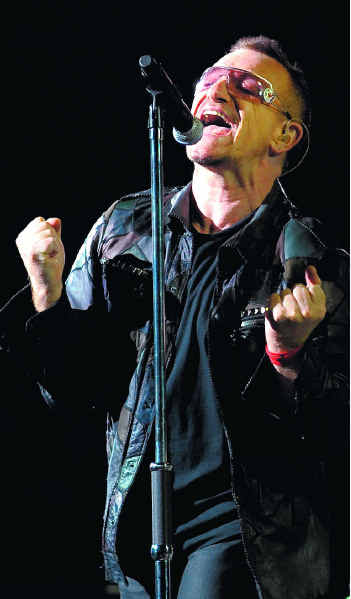
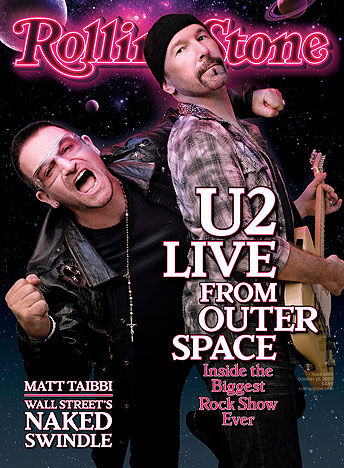
Bono Tax WTF?

Bono Tax WTF?

Ireland’s Finance Minister Brian Lenihan has introduced new measures that will hit the Irish rich where they live, literally. Major figures such as Bono and others members of U2, as well as many leading businessmen, are essentially tax exiles from Ireland despite being citizens.

Now however, if you hold an Irish passport and have extensive holdings in Ireland, Lenihan said he will introduce a $300,000-per-year  levy on “all Irish nationals and persons domiciled here who earn more than $1.5 million in income worldwide, and who have capital located here worth more than $7.4 million.”


U2 scores big in 2009

U2 Top Grossing Concerts 2009

The concert industry continued a recession-proof boom in 2009, with U2’s “360 Tour”leading the way, according to year-end numbers issued by ticket resale marketplace StubHub.

The eBay unit’s gross dollar sales for concert tickets increased 40% from 2008, marking a second consecutive year of growth at that level, while there was a 65% increase in concert ticket volume.

U2’s elaborate show was the top-grossing tour of the year, as well as the top-grossing concert tour in StubHub’s 10-year history, outdoing “Hannah Montana”and Police tours in 2007-08 and Madonna’s “Sticky and Sweet”trek of last year.

Trailing the Irish band as top grossers this year were Bruce Springsteen, Phish, Taylor Swift, Britney Spears, the Dave Matthews Band, Elton John, the Jonas Brothers, Kenny Chesney and Metallica.

U2 was responsible for nine of the 10 top-grossing individual concerts of 2009, with a pair of shows at New Jersey’s Giants Stadium heading the list. A Springsteen venue-closing concert at Giants Stadium ranked 10th.


U2 Best Album 2009 Rolling Stone Poll

U2’s No Line On The Horizon tops Rolling Stone’s Best Albums of 2009 poll 

U2’s latest album No Line On The Horizon has emerged as the topper in Rolling Stone magazine’s Best Albums of 2009 poll.

The release is U2’s 12th music album, and has beaten Bruce Springsteen’s Working on a Dream, Wolfgang Amadeus Phoenix by Phoenix and Jay-Z’s The Blueprint 3, reports Contactmusic.

Meanwhile, U2 have also scored the Best Song of 2009 honour with Moment of Surrender.

The song beat Empire State of Mind by Jay-Z and Alicia Keys and Bruce Springsteen’s Outlaw Pete among the editors’ picks.

Christopher Lawrence released a free bootleg remix

As the buzz increased tonight we thought we would introduce the fact that Chris has released a free bootleg remix of U2’s massive single ‘I’ll Go Crazy If I Don’t Go Crazy Tonight’. We have created a link for the download below.

The single is the fifth track from U2’s new album ‘No Line on the Horizon’. It was one of the highlights of U2’s recent European leg of the tour.

‘I’ll Go Crazy If I Don’t Go Crazy Tonight’ was originally released in the UK on September 7th by Mercury. Other artists who have released remixes include Dirty South, Fish Out Of Water, and Redanka.

Christopher Lawrence kicks up the energy level a notch with this hot new bootleg remix built around a groovy acid bass line and syncopated percussion. Use of the original vocals create dancefloor tension in the build up out of the breakdown. Classic progressive house and trance sounds were used effectively but sparingly to give the track room to breathe.

Christopher Lawrence Christopher says of the remix “being given the opportunity to remix one of U2’s songs was a dream come true. Bono’s voice is a such a signature sound to the band’s identity, I felt it was important to use as much of the original vocals of the song as possible to maintain the integrity of the song”.

U2 collaborated with will.i.am in the creation of the track. It was first developed by Brian Eno under the title “Diorama” during a break in the recording sessions. Several of the song’s lyrics were influenced by Barack Obama’s presidential campaign. Bono stated to Q magazine that the lyrics “[sound] like a T-shirt slogan to me”, also noting that it was No Line on the Horizon’s equivalent to “Beautiful Day”.

U2 Tour Should Gross $750 Million

Bono / Paul The U2 tour will probably gross $750 million by the time it finishes in 2010, according to band manager Paul McGuinness.

He told the Financial Times that the 44 sold-out dates since June, which saw the band play in front of 3.2 million people, grossed about $320 million.

With a similar number of dates planned for 2010, he calculates the full tour should gross about $750 million including merchandise sales, dwarfing the $389 million the act grossed on the Vertigo tour in 2005 and 2006.

He says using the 360º stage has enabled each venue to increase capacity by one-fifth. Partly because of the custom-built, claw-shaped set, the tour costs are about $750,000 a day, “whether we play or not.”

He says the tour should still be “highly profitable” but very often that gross figure is carelessly written about as having gone “straight into Bono’s pocket.”

McGuinness also told the FT about the importance of attention to detail when auditing the band’s payments from record companies and publishers.

“On not one of those occasions did we fail to uncover an underpayment,” he said.


No Line references to God

Many people have argued that U2 is really a Christian band that has achieved the ultimate crossover success.  Others say they were a Christian band that have fallen away from their faith.  I argue that they are a band that express their whole lives in their music, faith, love, dirt, everything.  It shouldn’t surprise people when someone who has a lot of faith then expresses it in their music. 

Many people see the Joshua Tree album as the defining moment in the argument, particularly the song I Still Haven’t Found What I’m Looking For. 

Critics point to this song as U2’s declaration of faithlessness (This was a hot topic when I was younger and one of the reasons my mom didn’t want me to listen to U2).  I say it is only a natural response to the difficulties of maintaining faith. 

If you start at the top of a mountain traveling to a village in the valley, as you wind your way down the trail you sometimes reach points you don’t see your destination anymore.  Sometimes during these times it seems hard to travel on but when you see your destination again you receive renewed energy and pick up the pace.  Some think U2 in …Looking For are describing one of those moments you find yourself on a particularly long stretch of road were you can’t see the village below.  The point is, though, you keep walking and you will reach it eventually. The best list of bible references has been maintained Angela Pancella( @U2).We have included some of Angela’s work here. 

“We’ve found different ways of expressing it, and recognized the power of the media to manipulate such signs. Maybe we just have to sort of draw our fish in the sand. It’s there for people who are interested. It shouldn’t be there for people who aren’t.”—Bono on faith, quoted in “U2 at the End of the World”

No Line On The Horizon

“Magnificent”

“It was a joyful noise” — Psalm 100:1: “Make a joyful noise unto the LORD, all ye lands.” (King James; see also Psalm 66:1, Psalm 81:1, Psalm 95:1-2, Psalm 98:4,6)

“Justified till we die” — the concept of being “justified” shows up all over the place, particularly in Paul’s letters, see for instance Romans 8:30: “Moreover whom he did predestinate, them he also called: and whom he called, them he also justified: and whom he justified, them he also glorified.” (King James)

“You and I will magnify” — Luke 1:46-55 is the song of Mary known as the Magnificat for its first line, rendered in King James as “My soul doth magnify the Lord, And my spirit hath rejoiced in God my Saviour.”

“Moment of Surrender”

“It’s not if I believe in love/But if love believes in me” — echoes 1 John 4:10: “This is love: not that we loved God, but that he loved us and sent his Son as an atoning sacrifice for our sins.”

“At the altar of the dark star” — See “Slide Away” (below)

“Unknown Caller”

“3:33 when the numbers fell off the clockface” — see the cover art for All That You Can’t Leave Behind and its reference to Jeremiah 33:3: “Call to me and I will answer you and tell you great and unsearchable things you do not know.” Bono told Rolling Stone, “It’s known as ‘God’s telephone number.’”

“Cease to speak that I may speak” — may reference Psalm 46:10: “Be still, and know that I am God; I will be exalted among the nations, I will be exalted in the earth.”

“I’ll Go Crazy If I Don’t Go Crazy Tonight”

“Is it true that perfect love drives out all fear” — more 1 John 4, this time 18: “There is no fear in love. But perfect love drives out fear, because fear has to do with punishment. The one who fears is not made perfect in love.”

“Stand Up Comedy”

“I can stand up for hope, faith, love” — 1 Corinthians 13:13: “And now these three remain: faith, hope and love. But the greatest of these is love.” (See “Elvis Ate America.”)

“God is love”— 1 John 4:16: “And so we know and rely on the love God has for us. God is love. Whoever lives in love lives in God, and God in him.” (I’m just going to start calling this album 1 John 4 from now on.)

“White As Snow”

“Who can forgive forgiveness where forgiveness is not/Only the lamb as white as snow” — John 1:29: “The next day John saw Jesus coming toward him and said, ‘Look, the Lamb of God, who takes away the sin of the world!’” (Also see Exodus 12 for a description of the sacrificial lamb of Passover being without blemish.)

“Cedars of Lebanon”

Oh gosh, mentions of the cedars of Lebanon are scattered throughout the Bible. See Song of Solomon 5:15: “His legs are pillars of marble set on bases of pure gold. His appearance is like Lebanon, choice as its cedars.”

Go, shout it out, rise up -

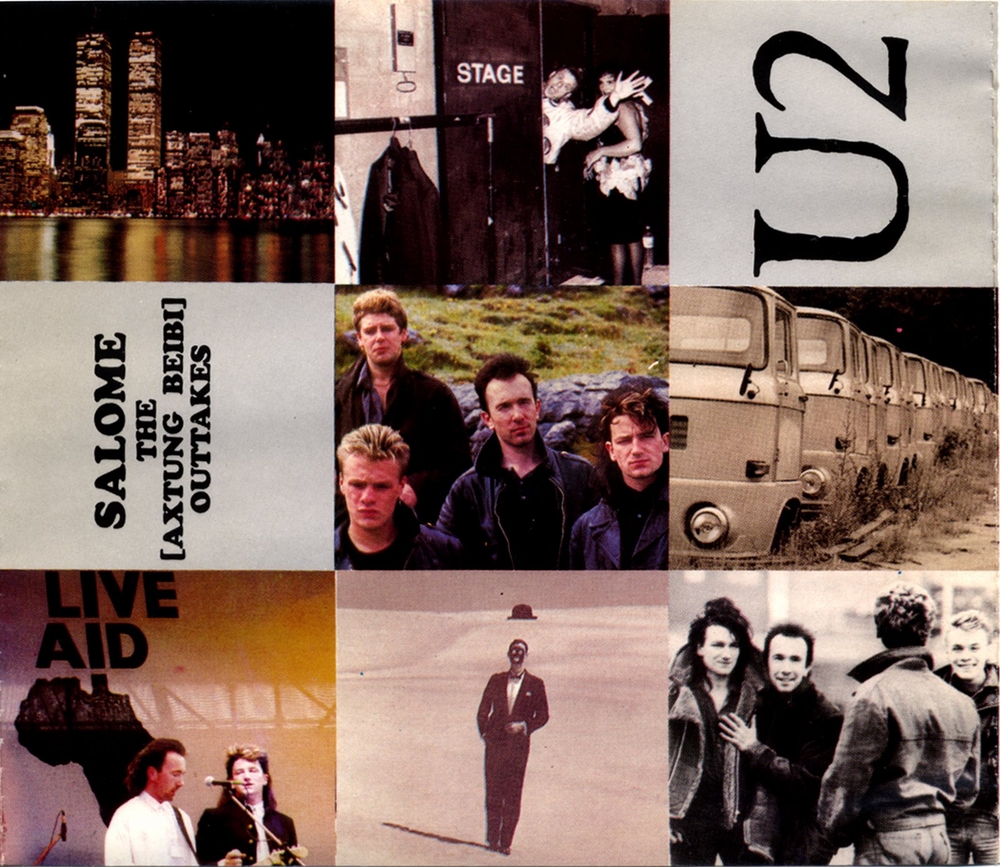
Salome: The [Axtung Beibi] Outtakes

In the winter of 1990, U2 were hard at work in Hansa Ton recording studios in Berlin, Germany. The ultimate result of this effort would be the November 1991 release of their next album, Achtung Baby. However, in December 1990 that album was a great ways off, because U2 (unlike most other bands) entered the studio with very few lyric or song ideas.

Instead, U2 came into the studio to create as well as record. Here they sought inspirations for songs from playing together. They would etch out ideas while improvising around some basic idea, or riff. Since all this jamming was taking place in a recording studio, even the simplest of ideas was captured on tape. The highlights of these tapes were then edited down and compiled into “working tapes” recorded onto DAT (Digital Audio Tape) cassettes. Tapes of this nature were used to hold possible song ideas, as well as a means for Brian Eno (and others) to hear the band’s progress and make suggestions about the music.

In April of 1991, it was announced that the tapes had found their way into the hand’s of bootleggers. Since then, the U2 working tapes have been pressed in a variety of forms:

May 1991: The New U2: Rehearsals and Full Versions
The debut pressing of the sessions. Available on vinyl only, as two separate double album packages. The covers were identical except for the colors of the lettering. One cover featured silver lettering, while the other had gold. In this pressing both LP’s of the silver lettered album proved to be identical. This resulted in four LP’s being released, but with only three LP’s worth of material.

June 1991: The New U2: Rehearsals and Full Versions
It was widely rumored that the set had been pressed again, but this time without any duplication between the LP’s. If true, this meant that there were now four LP’s worth of material available.
 

November 1991: The New U2: Rehearsals and Full Versions. This time the pressings were released as a boxed set of 5 LP’s. Surprisingly, there was no duplication within the set. All of these LP’s were pressed on translucent vinyl, in either blue or green (pink pressings have also been rumored).

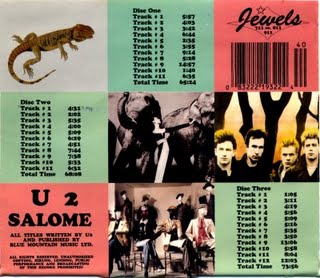
February 1992: Salome: The [Axtung Beibi] Outtakes This was the release that had been deemed “too hot” to ever be pressed. The complete three and half hours worth of material were now available as a triple compact disc set. Since these CD’s were mastered from the original DAT recordings, there’s no quality loss between the original working tapes and these CD’s. Thus the sound quality is far superior to the LP’s. The title (Salome) is believed to have been a working title used during the Achtung Baby sessions, but it’s not clear which song it was refering to. With these releases U2 found themselves in the dubious position of being:

“the first major band to have studio sessions released before the finished product was either released, abandoned or the group broke up”.

U2’s manager Paul McGuiness reacted to the bootlegs by releasing a press statement accusing the bootleggers of cheating the fans by passing off inferior material. He also stated that the finished product had evolved by leaps and bounds from what was being illegally circulated.

Regardless of the superior polish of the finished material released as Achtung Baby, the material found on the bootlegs is fascinating in and of itself. The most compelling aspect of the bootleged material is that, rather than offering slightly alternative versions of tracks found on the finished record, they instead reveal the songwriting process itself. Familiar solos, bass lines, bridges and riffs abound, and there is also a host of interesting songs that didn’t find their way onto Achtung Baby.


U2
S A L O M E
The [Aktung Beibi] Outtakes
1991/1993

CD 1

01 - Salome #1
02 - Where Did It All Go Wrong #1
03 - Where Did It All Go Wrong #2
04 - Heaven And Hell
05 - Doctor Doctor
06 - Jitterbug Baby
07 - Got To Get Together
08 - Salome #2
09 - Here Comes The Sunset
10 - Chances Away
11 - Chances Away (Short)
12 - I Feel Free #1


CD 2

01 - I Feel Free #2
02 - Sweet Baby Jane
03 - Who’s Gonna Ride Your Wild Horses #1
04 - Who’s Gonna Ride Your Wild Horses #2
05 - Who’s Gonna Ride Your Wild Horses #3
06 - Take Today (Instrumental)
07 - Even Better Than The Real Thing
08 - Blow Your House Down #1
09 - Blow Your House Down #2
10 - Laughing In The Face Of Love
11 - Wake Up Dead Man
12 - Take Today (Vocal)


CD 3

01 - Calling Out To Someone
02 - Laughing In The Face Of Love #2
03 - Acrobat
04 - Salome #3
05 - Who’s Gonna Ride Your Wild Horses #4
06 - Wake Up Dead Man (Mix)
07 - [Unnamed] (Instrumental)
08 - Salome #4
09 - Salome #5
10 - Salome #6
11 - Salome #7
12 - Salome #8


There were now 5 LP’s worth of material available, which came to a staggering total of 3 hours, 27 minutes, and 28 seconds.