Salman Rushdie joins U2 on stage

Novelist Salman Rushdie was in hiding for fear of his life for many years. Then he showed up onstage with U2. Then he wrote a song with them. In this extract from a piece in The Sunday Times he recalls how it all came about.

In the summer of 1986, I was travelling in Nicaragua, working on the book of reportage that was published six months later as The Jaguar Smile. It was the seventh anniversary of the Sandinista revolution, and the war against the US-backed Contra forces was intensifying almost daily. I was accompanied by my interpreter, Margarita, an improbably glamorous and high-spirited blonde with more than a passing resemblance to Jayne Mansfield. Our days were filled with evidence of hardship and struggle: the scarcity of produce in the markets of Managua, the bomb crater on a country road where a school bus had been blown up by a Contra mine.

One morning, however, Margarita seemed unusually excited. “Bono’s coming,” she cried, bright-eyed as any fan, and then added, without any change in vocal inflection or dulling of ocular glitter: “Tell me, who is Bono?”

In a way, the question was as vivid a demonstration of her country’s beleaguered isolation as anything I heard or saw in the frontline villages, the destitute Atlantic Coast bayous or the quake-ravaged city streets.

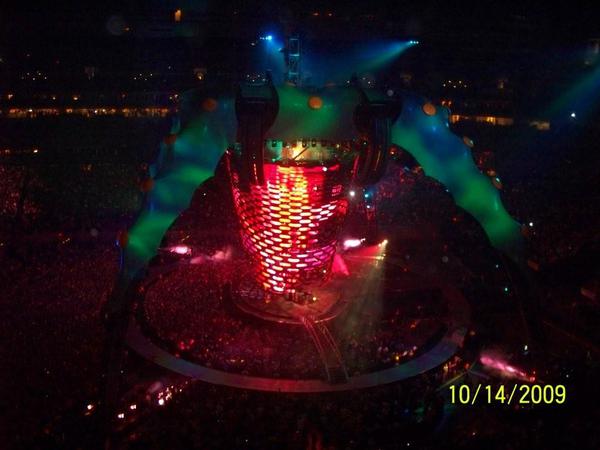
In July 1986, the release of U2’s monster album, The Joshua Tree, was still nine months away, but they were already, after all, the masters of War. Who was Bono? He was the fellow who sang: “I can’t believe the news today, I can’t close my eyes and make it go away.” And Nicaragua was one of the places where the news had become unbelievable, and you couldn’t shut your eyes to it, and so of course he was there. I didn’t meet Bono in Nicaragua, but he did read The Jaguar Smile. Five years later, when I was involved in some difficulties of my own, my friend the composer Michael Berkeley asked if I wanted to go to a U2 Achtung Baby gig, with its hanging psychedelic Trabants. In those days, it was hard for me to go most places, but I said yes, and was touched by the enthusiasm with which the request was greeted by U2’s people. And so there I was at Earls Court, standing in the shadows, listening.

Backstage, after the show, I was shown into a mobile home full of sandwiches and children. There were no groupies at U2 gigs, just creches. Bono came in, and was instantly festooned with daughters. My memory of that first chat is that I wanted to talk about music and he was keen to talk politics - Nicaragua, a protest against nuclear waste at Sellafield, his support for me and my work. We didn’t spend long together, but we both enjoyed it.
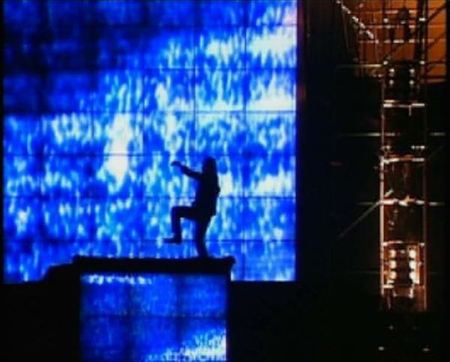
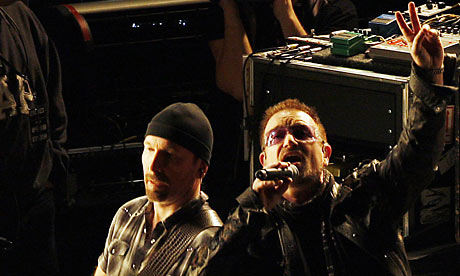
Two years later, when the Zooropa tour arrived at Wembley Stadium, Bono called to ask if I’d like to come out on stage. U2 wanted to make a gesture of solidarity, and this was the biggest one they could think of. When I told my then 14-year-old son about the plan, he said: “Just don’t sing, dad. If you sing, I’ll have to kill myself.” There was no question of my being allowed to sing - U2 aren’t stupid people - but I did go out there and feel, for a moment, what it’s like to have 80,000 fans cheering you on.

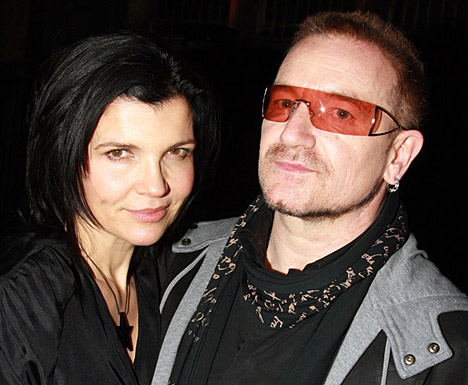
The audience at the average book reading is a little smaller. Girls tend not to climb onto their boyfriends’ shoulders, and stage-diving is discouraged. Even at the very best book readings, there are only one or two supermodels dancing by the mixing desk. Anton Corbijn took a photograph that day for which he persuaded Bono and me to exchange glasses. There I am, looking godlike in Bono’s wrapround Fly shades, while he peers benignly over my uncool literary specs. There could be no more graphic expression of the difference between our two worlds.

It’s inevitable that both U2 and I should be criticised for bringing these two worlds together. They have been accused of trying to acquire some borrowed intellectual “cred”, and I, of course, am supposedly star-struck. None of this matters very much. I’ve been crossing frontiers all my life - physical, social, intellectual, artistic borderlines - and I spotted, in Bono and the Edge, whom I’ve so far come to know better than the others, an equal hunger for the new, for whatever nourishes. I think, too, that the band’s involvement in religion - as inescapable a subject in Ireland as it is in India - gave us, when we first met, a subject, and an enemy (fanaticism) in common. An association with U2 is good for one’s anecdote stock. Some of these anecdotes are risibly apocryphal.

A couple of years ago, for example, a front-page Irish press report confidently announced that I had been living in “the folly” - the guesthouse with a spectacular view of Killiney Bay that stands in the garden of Bono’s Dublin home - for four whole years. Apparently, I arrived and departed at dead of night in a helicopter that landed on the beach below the house. Other stories that sound apocryphal are, unfortunately, true. It is true, for example, that I once danced - or, to be precise, pogoed - with Van Morrison in Bono’s living room. It is also true that in the small hours of the following morning, I was treated to the rough end of the great man’s tongue. (Mr Morrison has been known to get a little grumpy towards the end of a long evening. It’s possible that my pogoing wasn’t up to his exacting standards.)

Over the years, U2 and I discussed collaborating on various projects. Bono mentioned an idea he had for a stage musical, but my imagination failed to spark. There was another long Dublin night (a bottle of Jameson’s was involved) during which the film director Neil Jordan, Bono and I conspired to make a film of my novel Haroun and the Sea of Stories. To my great regret, this never came to anything, either.

Then, in autumn 1999, I published my novel The Ground Beneath Her Feet, in which the Orpheus myth winds through a story set in the world of rock music. Orpheus is the defining myth for both singers and writers - for the Greeks, he was the greatest singer as well as the greatest poet - and it was my Orphic tale that finally made possible the collaboration we’d been kicking around. It happened, like many good things, without being planned.
I sent Bono and U2’s manager, Paul McGuinness, prepublication copies of the novel, in typescript, hoping that they would tell me if the thing worked or not. Bono said afterwards that he had been worried on my behalf, believing that I had taken on an impossible task, and that he began reading the book in the spirit of a “policeman” - that is, to save me from my mistakes. Fortunately, the novel passed the test. Deep inside it is the lyric of what Bono called the novel’s “title track”, a sad elegy written by the main male character about the woman he loved, who has been swallowed up in an earthquake: a contemporary Orpheus’s lament for his lost Eurydice.

Bono called me. “I’ve written this melody for your words, and I think it might be one of the best things I’ve done.” I was astonished. One of the novel’s principal images is that of the permeable frontier between the world of the imagination and the one we inhabit, and here was an imaginary song crossing that frontier. I went to McGuinness’s place near Dublin to hear it. Bono played the demo CD to me in his car. Only when he was sure that I liked it - and I liked it right away - did we go back indoors and play it for the assembled company.

There wasn’t much, after that, that one would properly call “collaboration”. There was a long afternoon when Daniel Lanois, who was producing the song, brought his guitar and sat down with me to work out the lyrical structure. And there was the Day of the Lost Words, when I was called urgently by a woman from Principle Management, who look after U2. “They’re in the studio and they can’t find the lyrics. Could you fax them over?” Otherwise, silence, until the song was ready. I wasn’t expecting it to happen, but I’m proud of it.
For U2, too, it was a departure. They haven’t often used anyone’s lyrics but their own, and they don’t usually start with the lyrics: typically, the words come at the very end. But somehow it all worked out. I suggested facetiously that they might consider renaming the band U2+1, or, even better, Me2, but I think they’d heard all those gags before. There was a long alfresco lunch in Killiney, at which the film director Wim Wenders startlingly announced that artists must no longer use irony. Plain speaking, he argued, was necessary now: communication should be direct, and anything that might create confusion should be eschewed. Irony, in the rock world, has acquired a special meaning. The multimedia self-consciousness of U2’s Achtung Baby/Zooropa phase, which simultaneously embraced and debunked the mythology and gobbledegook of rock stardom, capitalism and power, and of which Bono’s white-faced, gold-lam�-suited, red-velvet-horned MacPhisto incarnation was the emblem, is what Wenders was criticising. Characteristically, U2 responded by taking this approach further, pushing it further than it would bear, on the less well-received PopMart tour.

After that, it seems, they took Wenders’s advice. The new album, and the Elevation tour, is the spare, impressive result. There was a lot riding on this album, this tour. If things hadn’t gone well, it might have been the end of U2. They certainly discussed that possibility, and the album was much delayed as they agonised over it. Extracurricular activities (mainly Bono’s) also slowed them down, but since these included getting David Trimble and John Hume to shake hands on a public stage, and reducing Senator Jesse Helms - Jesse Helms! - to tears, winning his support for the campaign against Third World debt, it’s hard to argue that these were self-indulgent irrelevances.

At any event, All That You Can’t Leave Behind turned out to be a strong album, a renewal of creative force, and, as Bono put it, there’s a lot of goodwill flowing towards the band right now. I’ve seen them three times this year: in the “secret” pretour gig in London’s Astoria theatre, and twice in America, in San Diego and Anaheim. They’ve come out of the stadiums to play arena-sized venues that seem tiny after the gigantism of their recent past. The act has been stripped bare; essentially, it’s just the four of them, playing their instruments and singing their songs. For a person of my age, who remembers when rock music was always like this, the show feels simultaneously nostalgic and innovative. In the age of choreographed, instrument-less little-boy and little-girl bands (I know the Supremes didn’t play guitars, but they were the Supremes), it’s exhilarating to watch a great grown-up quartet do the fine, simple things so well. Direct communication, as Wim Wenders said. It works. And they’re playing my song.

Read the whole of Salman Rushdie’s story at : The Sunday Times.

U2 adds opening act

When U2 lands at Rice-Eccles Stadium on June 3, the band will have an opening act in tow — Lenny Kravitz. Grammy Award-winning guitarist/producer/songwriter was in 1998 when he appeared at the HORDE Festival at the Canyons Resort.

Kravitz, who turns 46 in May, is a great showman and musician. I can’t wait to see him open for U2.

Tickets will go on sale Monday, Feb. 22, at 10 a.m. at all SmithsTix locations. Tickets can also be purchased by calling 801-467-8499 or 800-888-8499 or by logging on to www.smithstix.com

U2 going home empty-handed at Meteor Awards

IT WAS a night of surprises at the Meteor Ireland Music Awards, with U2 going home empty-handed for the first time.

The band were beaten in all three categories: best band, best album and even best live performance.

It was a surprise in particular for The Coronas whose sophomore album Tony Was An Ex-Con was voted best Irish album ahead of U2’s No Line on Horizon by music fans.

“I know people say this all the time, but we really, really didn’t expect this,” said lead singer Danny O’Reilly. “We just assumed like everyone else that U2 would win. We hadn’t a clue.”

Expressing equal incredulity at their award was The Script, who won for the best Irish live performance of the year for their barnstorming set at Oxegen, even though U2 played three shows at Croke Park to nearly 250,000 concert-goers.

Drummer Glenn Power said they had not expected to win and had no script written. Snow Patrol was voted best band.

U2 bass player Adam Clayton was the only member of the band to turn up. He presented the industry award to Lord Henry Mountcharles, the owner of Slane Castle.

Singer-songwriter Wallis Bird followed up last year’s Hope for 2009 Meteor Award with the award for best female ahead of the favourite Laura Izibor.

An emotional Bird seemed genuinely shocked to win. “If I had known this was going to happen I would have written a speech and worn better shoes,” she said referring to the scuffed red brogues she wore, in contrast to the vertiginous heels which were most in evidence last night.

It was a bitterly cold night outside the RDS Simmonscourt, with many of the early arrivals shivering in their party dresses, but the awards attracted arguably the two hottest acts of the moment, Brit winners Florence and the Machine, who won a Meteor this year for best international band, and rapper Dizzee Rascal.

Dizzee Rascal said his duet at the Brits with Florence and the Machine lead singer Florence Welch earlier this week was “totally effortless”. You Got the Dirtee Love became one of the fastest selling downloads in history.

Dizzee also expressed a desire to record the Cranberries’ Zombie , a song he called a “massive tune”.

Veteran balladeer Christy Moore won best Irish male and, unsurprisingly, Westlife won the best Irish pop act for the tenth time.

U2 wins Pollstar Award/Week Wrap up

The 21st annual Pollstar Concert Industry Awards honored its own Wednesday night at the Nokia Theatre at LA Live in Los Angeles. The awards are held annually and honors the promoters, artist managers, booking agents and technical companies.
The winners are chosen by the people that make the concert scene happen. The show honored music artists and companies that helped the concert business in the 2009 year. It’s an insider’s look at which bands mattered in 2009.

Comedian Katleen Madigan hosted the show. A few of the celebrity presenters included Jay Osmond, Lamont Dozier, Don Felder, Al Jarreau, Alan Parsons, Rob Halford of Judas Priest and actor John O’Hurley.

Final date for “360” North American leg

If you live in Salt Lake City and missed out on seeing U2’s “360” tour last year, now is your chance!

U2 will play at the Rice Eccles Stadium on June 3rd. Tickets go on sale Monday, but presale access for U2.com subscribers begins tomorrow.

This will be the final date announcement for the North American leg of the tour, but it will be the day that U2 actually starts “360” up again this summer!

There was also some whispers that U2 would be playing another show in Dublin this summer at the O2, but those proved to be just whispers.

Vatican’s rock top-10: Beatles, U2, Pink Floyd

VATICAN CITY — The Vatican newspaper has come up with a “semi-serious” list of 10 essential rock and pop albums, including works by the Beatles, U2, Michael Jackson and Pink Floyd.

The list was offered in a tongue-in-cheek article Feb. 14 as an alternative to the music of Italy’s biggest pop music festival, which was to begin two days later. The “10 albums worth taking to a desert island” were listed in the chronological order of their release:

  • “Revolver” by the Beatles, described as more innovative than any of their successive albums.
  • “If I Could Only Remember My Name” by David Crosby. Its songs used experimental musical forms to express an “existential fragility,” the article said.
  • “The Dark Side of the Moon” by Pink Floyd, which the newspaper called an “amazing” and eminently enjoyable milestone in the history of rock music.
  • “Rumours” by Fleetwood Mac, which the article said mixed the sounds of blues, pop and country.
  • “The Nightfly” by Donald Fagen of Steely Dan. A niche album, but “brilliant and ironical,” according to the Vatican newspaper.
  • “Thriller” by Michael Jackson. The article described this album as “the masterpiece of the king of pop” and said its original approach went against the stereotypes of black music.
  • “Graceland” by Paul Simon, who used South African music with his own to create a multiethnic album that marked the birth of “world music,” the newspaper said.
  • “Achtung Baby” by U2, a disk that stands out for its music and lyrics, and remains a symbol of the ’90s, it said.
  • “(What’s the Story) Morning Glory?” by Oasis. The group picks up the great tradition of the Beatles, but with a harder edge of punk and rock, it said.
  • “Supernatural” by Carlos Santana, seen as an avant-garde mix of blues, soul, salsa and rock.

The article ended by explaining why it left Bob Dylan off its list. While acknowledging his “great poetic vein,” it said Dylan’s greatest fault was to have inspired a generation of amateur singer-songwriters who have “severely tested the ears and patience of listeners, thinking that someone might be interested in their tortured meanderings.”

Google Drills into Geothermal; Bono and U2, too

The United States — especially California — gets a substantial amount of non-hydro renewable energy from geothermal.  We’ve reported on new geothermal technologies in this EPRI article and recently summarized last year’s geothermal action

In fact, while solar and wind get all the headlines, geothermal quietly produced 4.5 percent of California’s total system power in 2007, with more than 40 operating geothermal plants in the state. Most U.S. geothermal installed capacity remains concentrated in California; in 2005, California’s geothermal power capacity was more than that of every country in the world, according to the GEA.

Charles Baron, Google’s geothermal program lead, spoke in San Francisco at this week’s GeoPower Americas 2010 gathering.  Baron is a geothermal enthusiast, as is Google.

As testament to its earnestness about geothermal, Google has invested in geothermal start-ups Altarock Energy and Potter Drilling.  Google has also invested in a number of other renewable energy firms, including solar firms BrightSource Energy and eSolar and high-altitude wind innovator Makani Power

Google has issued geothermal grants, as well.

Google issued a grant to Southern Methodist University’s geothermal lab for geothermal resource mapping, in what seems an obvious synergy with Google Earth.  Much of today’s geothermal data mapping is based on data collected in the 1970s.  Since then, millions of geothermal data points have been collected from oil, gas and geothermal exploration but have not been aggregated and analyzed.  The grant supports SMU in aggregating data for the most under-sampled regions of the U.S. and in developing new methodologies for estimating geothermal resources, according to Google’s Baron. 

Stanford University also received a geothermal-focused grant from Google to investigate single-well systems. 

On the global side, the technical community faces a formidable challenge when it comes to developing ways “to speak apples to apples about geothermal” measurements across different regions.  It will be important to come up with a common language to communicate about global geothermal resources, according to Baron.

Baron also posed the question, is geothermal interesting to VCs?

The answer is somewhat nuanced.  If geothermal is going to be a good fit for the venture capital asset class, investments will have to be in technology that is, “extremely disruptive,” requiring significant “technology whitespace.”

U2, Lady Gaga and Westlife tipped for Meteor success

Irish rockers U2, ‘Poker Face’ star Lady Gaga and chart-toppers Westlife are being hotly tipped to clean up at this year’s Meteor Music Awards.

Voting lines have now closed and Paddy Power are now finished betting on the event but the closing odds suggest the three acts will walk away with major gongs on the night.

U2 finished up 1/4 favourites with Paddy Power to win Best Irish Live Performance, while Lady Gaga, who cleaned up at the Brits, finished at closing odds of 1/2 to win Best International Female.

As for Westlife, the lads are heading for their tenth consecutive Meteor Award for Best Irish Pop Act at odds of 1/10!

In other categories, Today FM’s Ray Foley has been backed off the boards to win Best National DJ at 1/6 while Florence & The Machine could pip Lady Gaga to the post in the Best International Album category following a late gamble at odds of 9/4.

In the Best Irish Male category Paddy Power prematurely suspended betting after seeing one-way traffic for folk legend Christy Moore at 8/13.

Sharon McHugh, spokesperson for Paddy Power said: “Most of the money has been for U2, Lady Gaga and Westlife but the Meteors have thrown up a few surprises over the years so as the saying goes it’s not over ‘til the fat lady sings!”

U2TOURFANS adds more features to iPhone/iTouch Application

A departure from the norm, thats what the Chief Editor called this new release. The idea that fans are only american or only from the UK seems a bit out of touch. This lastest release blends the best of the fan based U2 sites from around the world. Starting with South America, If you believe your site should be considered drop us an email.  Check them all out via our application.


Bono attending NYC Fashion Week

U2 frontman, Bono, was in New York for Fashion Week this week and much to the delight of skinny models, rich fashion designers and snobby celebs, the Irish rock star crashed a well known fashion party on Tuesday night.

Bono, who brought some friends, kindly dropped in to meet and greet the designers of Rodarte to tell them how wonderful he thinks their clothes are. Wonder does he even wear their clothes or was he just looking to party with skinny models? Ummm!

Rodarte is a brand of clothing and accessories founded by Kate and Laura Mulleavy.

Bono stayed for a long while chatting to everyone and anyone including British actress and model, Karen Elson.

The party, which was held at the Black Market in the East Village, erupted when they saw the famous rockstar come through the doors.

Also at the party was Natalie Portman, Kirsten Dunst, Spike Jonze and Jason Schwartzman.

Rodarte designer and co-founder Kate Mulleavy said “Of course I’m delighted he came, I’m a huge fan.”

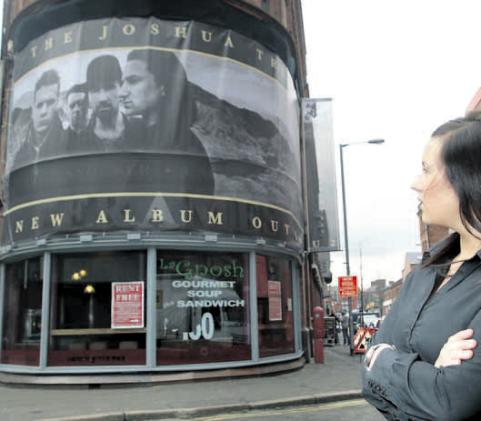
Was that U2 spotted around Belfast bar ?

Caitlin McCormack, who works in Frames Bar, looks at the poster for Killing Bono If you dander past Little Donegall Street in Belfast over the next few days and wonder if you have stepped back in time, don’t fret, it’s not the 1980s — despite the obvious reference.

Yesterday passers-by were intrigued by the appearance of a massive poster advertising the release of arguably U2’s greatest album, The Joshua Tree.

The iconic image of a very young, sombre-looking group of lads from Dublin has been mounted across the front of the Frames complex, with two side banners heralding the release of the band’s fifth studio album.

Of course, The Joshua Tree was released in 1987. So why the advertisement? Well, the poster (and Little Donegall Street) is part of a scene from music comedy Killing Bono, being filmed in Belfast.

The movie, which stars Ben Barnes from Chronicles Of Narnia fame and Channel 4 ‘Misfit’ Robert Sheehan, is based on a book written by Neil McCormick, who went to school with U2 frontman Bono.

I Was Bono’s Doppelganger tells the story of McCormick and his brother Ivan’s attempt to forge a career in the music industry during the 1970s. But the pair fail to find success, while Bono and Co went on to achieve superstar status.

The last day of filming is tomorrow. There will be a night shoot from 8pm - 5am outside Frames on Library Street. and if you want to be part of it as an extra just go along in 80’s fashion. Text 07792490926 with your full name to confirm you’re going. Remember its outside so wear sensible clothing.


U2 Salt Lake City Update

The U2.com fanclub presale times for the Salt Lake City show on 3 June 2010 have been updated sent out today via email.


Horizon subscribers: 10am, Thursday 18 February
Breathe subscribers: 3pm, Thursday 18 February

Boots subscribers: 10am, Friday 19 February
Magnificent subscribers: 3pm, Friday 19 February

The presale closes at 5pm on Saturday 20 February for all subscribers.

The public sale will begin at 10am on Monday 22 February.

Bono embracing 50

 U2’s vibrant frontman Bono has the kind schedule that would make us normal people spin uncontrollably. However he did take the time to reflect on what he would like to accomplish this year, as a member of U2 and as a regular guy.

The February issue of the UK’s “Q” magazine, Bono lets loose in a small feature titled “Bono’s 5 Step Plan to Take over the World”. First on the list for Bono is obviously any new music that U2 are testing out.

“We’ve been listening to new material for “Songs of Ascent”. We haven’t fully decided to press ‘go’ on that,” Bono admitted about the spiritual record where the “360” opener “Kingdom of Your Love” came from. While still unsure as to what the band will focus on, he does feel the need for audiences this summer to hear some fresh tracks. “Even if it’s an EP or a single song,” he said.

Bono said  that the work he and Edge contributed to the “Spider-Man” musical for Broadway is “potentially one of the best things we’ve ever done” and while waiting for the show’s financial problems to be worked out, he expects the show to be running later this year.

Bono also discussed U2’s upcoming debut at the Glastonbury festival in June. He said that “everyone is excited” and because it’s on a smaller scale than “360”, expect a performance without so much spectacle. “I think it will just be about the music on that day,” Bono said.

Also on his mind was (RED) and Bono was happy to report new developments shaping up. Nike has joined the campaign, he revealed, and Africa’s hosting of the World Cup this year is something he is truly thrilled about. “It’s important that the world gets to see the majesty and magical side of that most extraordinary continent,” he said.

As incredible as Bono’s year sounds so far, perhaps the most special event will take place on May 10, when he turns 50. And he already feels the pressure. After attending a Leonard Cohen concert last year where he got emotional during the show, Bono confessed, “I realized that all my favorite songs he wrote in his 50s and 60s. That, to me, was a throwdown.” However daunting as turning 50 seems, Age is nothing but a number, Bono!