“The Unforgettable Fire”

— Irish band U2 released “The Unforgettable Fire” in late 1984. At the time, Bono was developing into not only the band’s charismatic leader. The time also marked the beginning of his more outspoken diatribes against injustices. And while some of the songs on the album weren’t as fully developed as the band’s future work, that chapter in the group’s history gets an upgraded overview that’s worth revisiting on the reissue of the updated, two-disc reissue of “The Unforgettable Fire” (Island).

On earlier albums, such as “Boy” and “War,” U2 made it clear that they had no problem wearing their hearts on their sleeves and their fists in the air as they proudly exhibited youthful rebellion.

But their world view became even wider thanks to their burgeoning notoriety. Despite having success and adulation, they were more acutely aware of the wrongs they saw in their expanded world view. Bono became enthralled with Martin Luther King Jr. during this period. King’s spirit is audibly alive on the defiant “Pride (In the Name of Love),” the album’s big single, and “MLK,” one of the set’s standout tracks.

Elsewhere on the album, U2 effortlessly conjures iconic images in their focus on the Unites States and its rich history, as heard on the solemn “Elvis Presley and America” and the equally stunning “4th of July.”

“Bad,” the disc’s emotional centerpiece, now takes on an eerie, almost hypnotic air in light of the world’s increasing fragmentation, with its message continuing to resonate as dramatically as it did more than 25 years ago.

The second disc in the package will confound collectors, as it includes a generous selection of rarities and remixes, most notably live versions of “A Sort of Homecoming” and “Bad,” outtakes like “Love Comes Tumbling,” plus a magnificent remix of “Wire” that will put a smile on the face of any U2 fan.

This is the album that linked U2’s youthful restlessness to their compelling maturity, as their next album, 1987’s “The Joshua Tree,” would find them perfecting their own kind of rock ‘n’ roll that moves the body, challenges the mind and awakens the spirit.

This updated version of “The Unforgettable Fire” manages to give a deeper, fascinatingly detailed perspective of a band leaving behind its youthful restlessness and confidently maturing with purpose and grace.

U2 goes to Africa

Tribute albums are challenging because not only do the acts involved have to face the reality of knowing that their version of a well-known song will never match the original’s impact, but sometimes, participating in such a project might be more of a marketing ploy and not be such a “tribute” after all.

Neither is the case on “In the Name of Love: Africa Celebrates U2” (Shout! Factory).

Bono has campaigned for many causes to help the people of Africa. That commitment didn’t go unnoticed by music producer Shawn Amos, an African-American who originally went to Africa to help build housing and was inspired to put together this collection as not only a way to pay tribute to U2, but also as a way to give back.

Proceeds generated from the disc’s sales will go to the Global Fund, a charity that seeks to fight AIDS, tuberculosis and malaria in Third World Countries.

Amos not only shows his formidable abilities as a producer, but also as an arranger, staying true to the rhythms and essence of African music while tipping his hat to U2’s Bono, The Edge, Adam Clayton and Larry Mullen Jr.

This collection comes to life thanks to several breathtaking performances, including Tony Allen’s otherworldly “Where the Streets Have No Name,” Les Nubians’ chilling “With or Without You” and a spine-tingling recasting of “Pride (In the Name of Love)” by the Soweto Gospel Choir.

The most dramatic moment may belong to Keziah Jones, who glides over the poly-rhythmic grove of “One,” and delivers warm, transcendent vocals.

Jones sounds to deeply understand the song’s plea for unity. This song is the most touching moment on the disc, one that makes it sound less like a tribute album and more like a love letter from the dry, parched plains of Africa to the cold, narrow streets of Ireland.


Evening Empire

For some reason today the following book came up for review again. A departure from the normal U2 news, we thought it might be a fun little weekend read by the fire -
Evening’s Empire is an alternative history of the sixties generation that feels truer than what really happened. This is a funny, sad testament to the lost boys who wouldn’t grow up.”
— Bono

The Year Is 1967. In England, and around the world, rock music is exploding — the Beatles have gone psychedelic, the Stones are singing “Ruby Tuesday,” and the summer of love is approaching. For Jack Flynn, a newly minted young solicitor at a conservative firm, the rock world is of little interest — until he is asked to handle the legal affairs of Emerson Cutler, the seductive front man for an up-and-coming group of British boys with a sound that could take them all the way.

Thus begins Jack Flynn’s career with the Ravons, a forty-year journey through London in the sixties, Los Angeles in the seventies, New York in the eighties, into Eastern Europe, Africa, and across America, as Flynn tries to manage his clients through the highs of stardom, the has-been doldrums, sellouts, reunions, drug busts, bad marriages, good affairs, and all the temptations, triumphs, and vanities that complicate the businesses of music and friendship.

Spanning the decades and their shifting ideologies, from the wild abandon of the sixties to the cold realities of the twenty-first century, Evening’s Empire is filled with surprising, sharply funny, and perceptive riffs on fame, culture, and world events. A firsthand observer and remarkable storyteller, author Bill Flanagan has created an epic of rock-and-roll history that is also the life story of a generation.

BBC 'inappropriate' with U2 Album !

The BBC has admitted coverage of the launch of U2 album No Line On The Horizon last February, went too far - giving “undue prominence” to the band.

Critics said the BBC had given U2 “the sort of publicity money can’t buy”.

The corporation’s editorial complaints unit (ECU) acknowledged that radio coverage of the event, including a rooftop concert, breached guidelines.

It added the use of the slogan U2 = BBC “gave an inappropriate impression of endorsement”.

RadioCentre, the trade body for commercial radio companies, made a formal complaint over the coverage. 

U2 at the BBC
The surprise concert drew crowds of onlookers in central London

Complaints over the free publicity given to the band on BBC TV, radio and online included those of Conservative MP Nigel Evans, who said it was “the sort of publicity money can’t buy”.

“Why should licence fee-payers shoulder the cost of U2’s publicity?”

The ECU admitted that a reference to the BBC being “part of launching this new album”, in an interview between Radio 1 presenter Zane Lowe and U2 singer Bono, was inappropriate.

The body also upheld a complaint that it was inappropriate for the Radio 1 website to contain links to the websites of ticket agents for the band’s concerts.

‘Potentially sensitive’

“The Radio 1 leadership team have reminded executive producers and presenters about the issues to be considered in relation to judgments about undue prominence, and the distinction between the reporting of new artistic work and commercial promotion,” it said, earlier this week.

“The management of BBC Marketing, Communication and Audiences (the Division responsible for the U2 = BBC graphic) has reminded all staff of the need to consult the editorial policy team in a timely manner for advice when potentially sensitive issues such as commercial interests are involved.”

However, complaints about an edition of Jo Whiley’s Radio 1 show, and a BBC News online report of the U2 concert on the roof of Broadcasting House, were not upheld.

A crowd of around 5,000 watched the rooftop show, which capped off a day of promotion for the Irish band’s 12th studio album, with U2 appearing as special guests on Radio 1.

The band performed four tracks during the 20-minute gig, which was broadcast live on DJ Chris Evans’s BBC Radio 2 show.

U2TOURFANS Offers help Haiti

U2 fans we are setting up a way for our supporters to show some support. Consider your donation below or choosing one of the other links to show support.

Haiti has been hit by the first large earthquake in 240 years. The enormity of the effects of this devastating 7.0 quake are only barely understood at this time. Thousands may have been killed and tens of thousands left homeless. to make a difference. Please take this chance to lend them your support.

We thought a few lines from “ONE” would help all of us remember we are ONE.

One love
One blood
One life
You got to do what you should
One life
With each other
Sisters
Brothers
One life
But we’re not the same
We get to
Carry each other
Carry each other

One…life

One


U2TOURFANS has setup a link for donations that will be collected on behalf of its readers as well as our crew will be providing donations. We will post the total amount of the donations within the next 24hrs. Right now is the most important time to collect donations.


U2, Americal Idol, and Elevation DVD

Tour season is right around the corner and if you’re a fan you about jumping off the roof right about now. The band has been just kicking back, no major announcements. Of course lots of interesting rumors, should we pass them along? Well the only one worth throwing out is could it be possible that U2 allows the “artists” from American Idol to use their songs again? We asked the question last night on our Facebook fan page and course your welcome to throw up your comments too. Most say “Hell No”  

After watching a couple of minutes of AI we choose to dig into our DVD collection and attend a virtual concert.

U2 - Elevation Tour 2001: Live from Boston

After the huge, lavish spectacles of previous tours, U2  decided to tone things down a bit for Elevation, which accompanied their All That You Can’t Leave Behind album. Just as the album marked a return to a simpler more stripped-down sound, the live shows returned to smaller venues and a more intimate show, and from start to finish Elevation provides a welcome reminder of what a great band this is. Recorded in Boston, the show features a healthy mix of new and old songs, which were written over the course of two decades but sound as fresh and relevant as ever. From classics like “Sunday Bloody Sunday,” “Where the Streets Have No Name,” and “I Will Follow” right up to instant favorites such as “Beautiful Day” and “Elevation,” every track is stunningly executed. If you saw the concerts, this is a worthy and lasting souvenir; if you didn’t, watch this and you might be kicking yourself.

The disc does a great job of showing how straightforward the tour was. It was a big tour with a huge crew, but on stage the four musicians were pretty much on their own. The camera catches a few great close-ups of the members of the band in which you can really see their facial expressions. The Edge seemed quite preoccupied with playing the music. Larry Mullen and Adam Clayton seemed to be genuinely enjoying themselves. Bono played the rock star. There are a few great shots where you see The Edge looking to Larry Mullen for the rhythm. For a second they seem less like U2, and more like four guys in a band.

The setlist included songs from All That You Can’t Leave Behind, a few of the U2 classics, and a few refreshing unlikely choices (Gone, Bad, Stay (Faraway, so close), Until The End Of The World). The Edge used the set list as an opportunity to parade an amazing set of classic guitars including a full-bodied Gretsch, a pearl Telecaster, Edge’s classic Gibson Explorer, a Godin, a beautiful clear woodgrain finish Stratocaster, and a 12-string Richenbacher that The Edge kicks off the stage.

What we found most striking about the DVD was how great U2 is at putting on a rock concert. You can really see the experience of 20 years of touring. Bono plays the 20,000 strong audience like it was a percussive instrument. The Edge’s guitar and Bono’s voice alone can fill a stadium design for NHL hockey.

The album contrasts nicely with the material in the context of the concert. If Stuck in a Moment were a little more immature and unrefined, if would fit in perfectly on Rattle and Hum.

The live performances shed new light on some of what we had though where the weaker songs from All That You Can’t Leave Behind. New York, which always struck us as goofy (comparing the heat of New York to a “hair dryer in your face” just doesn’t hold up next to the biblical alegory of The End of the World- which Bono introduces this night with “this is judas”) and Walk On both shine make more sense in the live context.

Highlights include, the inclusion of Until The End Of The World and a great rendition of Stay (Faraway, so close). Introducing the band, Bono says “Even his mother calls him, The Edge”. The introductions to The Fly and Where the Streets Have No Nameare classic goosebump-inducing stadium rock moments.

Well how many more months away are we from the start ? 4 Months -

The Edge says he hates jamming

U2 guitarist the Edge is not a big fan of jamming. “I try and avoid it at all costs. Jamming is really the most awful, excruciating experience for me, I really don’t enjoy it,” he says.

“First of all, that’s not how I work as a guitar player. I compose using the instrument, I don’t really sit down and play for the sake of playing stuff.

“So the idea of jamming - endless, directionless noodling around some nondescript chord progression - I really find very boring.”

The Edge was in Dublin last week for the launch of the movie, “It Might Get Loud,” which focuses on guitarists Jimmy Page, The Edge and Jack White.

The Dublin launch was a rare respite from the monster 360 Tour which earned a whopping $123 million in the U.S. for the band, who sold more than 1.3 million tickets along the way

'Spider-Man' turns on the lights

“Spider-Man, Turn off the Dark,” the $50 million Broadway musical by Bono and The Edge, is back on – but not until fall 2010.

The show, the most expensive in Broadway history, was supposed to open in March at the Hilton Theater. It ran aground when David Garfinkle, its inexperienced and inept lead producer, failed to come with the money.Bono’s longtime business partner, Michael Cohl, stepped in to clean up the mess.

The financing is now in place, with a chunk coming from Disney, which recently acquired Marvel Comics. The show will likely begin previews in September and open in November, sources have said Refunds are now available for people who bought tickets for performances this spring — previews were supposed to have begun next month — and do not want to exchange them for new dates in the fall. “Cohl and Disney have sorted it all out,” one source said. “Garfinkle is around in name only.” Julie Taymor, who directed “The Lion King,” is staging “Spider-Man.” Alan Cumming is still on board as the Green Goblin. Spider-Man will be played by newcomer Reeve Carney.


Under the Big Top

Happy New Year, and please welcome our guest writer Nikki back -

By  Nikki Vanasse

Blackstone, MA

Crew Pass - ( Working Crew)U2’s convictions about live performance began even before the roots of their calling took hold. When teenagers form a band, they are most concerned with such details as learning their craft (U2 knew all of three chords and Adam barely knew how to pedal a bass), getting gigs, and making enough money to score a decent meal. For U2, it started with lighting.  The lighting had to be just right.  They obsessed with the lighting!  The visual aesthetic was nothing short of critical. The most recognizable show from their past, before The Joshua Tree tour, was the stage awakening that was the War Tour.  Red floors, white flags, stage climbing, camouflage draped over stage equipment; they were a band making a statement.  You see, it’s what they’ve always done. Statements about politics, religion, pop culture.  It should be no surprise to any hardcore fan that the shows evolved into what they are today.  The band’s fundamental philosophy was that the show had to be magnetic, keep everyone’s attention, and accessible to everyone.

Since the late 70’s when the boys were cutting their teeth on the local circuit, U2 always sought intimacy with their audience. The band performed at venues such as Dandelion Market in Dublin, Mount Temple, Trinity College, churches, youth clubs, and community centers mainly to provide access to the younger fans who essentially couldn’t get into the licensed pubs because they were simply too young.

U2 was born during a time when punk was on fire and rock bands were redefining the live rock show. In the late 60’s, Pink Floyd paved the way for the epic visual rock show followed by celebrated bands and artists such as Genesis, The Velvet Underground, and David Bowie. Bono’s MacPhisto, Mirror Ball Man and the Boxer characters are reminiscent of Peter Gabriel’s Green Man or David Bowie’s Ziggy Stardust or Thin White Duke. While U2 was yet to venture into such elaborate performances, these were some of the influences that tilled the soil that would soon cultivate the seeds of the operation we see today with their most technologically ambitious 360 Tour.

The minimalist stage sets of the Boy, Gloria, and War tours became increasingly difficult as the popularity of the band grew when The Unforgettable Fire was released and the tour had to be planned. The size of the venues were increasing and it became progressively difficult to keep the spectacle low-key.

At this time, Bono’s stage clothes consisted of a black knit mesh shirt, black and white checkered or black leather pants, and the mod black leather boots you could find anywhere in Europe at that time. Ironically enough, Adam, who has always been known as the most posh of the band even from the moment he answered Larry Mullen Jr.’s ad for a bass player at Mount Temple, often looked like any other kid cruising the streets back then. Except for the striking bush of blonde curls! The Edge and Larry dressed just like any other teenager you could find in Dublin. Today, they are very well put-together.

With War, things started to get more refined. There was also a lot of stage climbing by Bono. While the Unforgettable Fire proved more of a challenge for the stage design they had loved and proven successful, they still managed to create a very specific mood and atmosphere with large backdrops and monochromatic banners hanging above the stage.  With the explosion of The Joshua Tree, U2 was catapulted into superstardom and with that success, were provided the financial leverage to start exploring new presentations for the stage.
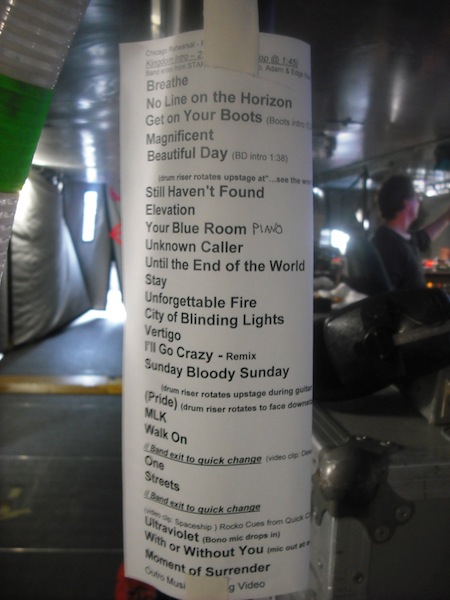
Another Show, Another town, another whateverWillie Williams has been a collaborator with the band on all aspects of their show since 1983. He takes direction straight from the band. They have always been in charge. In U2 Show (Diana Scrimgeour), he states that audiences assume that everything is spontaneous and controlled by the band; that it’s easy to change up the show on a whim from one night to another.  Not so.  It’s a very tight operation. The music goes hand in hand with the presentation and while there is some breathing room, there is little of it.

Williams has worked with many of the heavy hitters in rock such as R.E.M., David Bowie, and The Rolling Stones.  He states that “U2 is unique among their peers in respect of their approach to performing.” They are included in the design process from the time the very first thread of an idea is casually raised until the end of the tour.  Just like they’ve always done from the very beginning.

Williams’ job is to bring art to the stage and between tours, he gathers ideas.  He just doesn’t worry about the art of the show but what kind of show it might be.  He knows that fans don’t necessarily want U2 to change, but they also don’t want them to repeat themselves, and that’s a tremendous challenge.  About a year out from the first scheduled date of the tour (which in my opinion is a relatively short time to pull something together as massive as Zoo TV, Pop Mart, or 360!), Williams and the band come together like old school chums and begin churning ideas.  One of the most challenging pieces is figuring what technology is available, or on the cusp of availability by the time the show hits the road.  There’s a rule the design unit follows:  to conform to three concepts until there is that one idea that continues to interest and excite them.  Thus, the production is born.

While the designs are being discussed, ideas are funneled down to the band’s production manager, Dennis Sheehan (with the band since 1982), who is simultaneously covering details such as seeking bids from fabrication companies as soon as the design is settled, making sure the budget is on track with the accountants, and leading discussions with the entire tour team so that they get the idea and feel of the show and get proactive about any potential problems, in order to get in front of the 8-ball a bit.

Production rehearsals get underway and the crew spends two to four weeks constructing the show.  When shows are as complex as Zoo TV/Pop Mart/360, it’s critical to practice the set-up so that the crew can become as efficient as possible and iron out any difficulties or issues with the process.  This saves time.  Time is money.  With the cost of the current tour at $750,000, it’s an important factor.
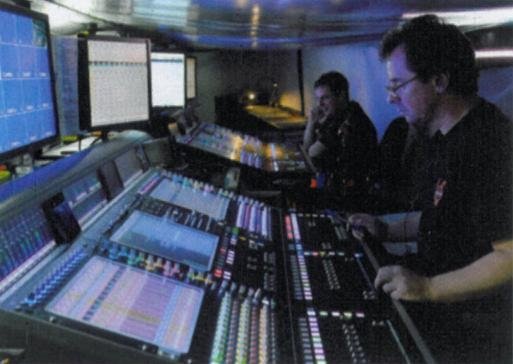
Control Room The production rehearsals are Williams’ opportunity to physically test all his concepts and plans regarding lighting, video effects, atmosphere…the mood and feel of the show.  Remember that throughout this entire process, everyone has input from the band to the entire tour team.  When the team says something might not work, it’s not always met with accord.  Even four weeks out from the launch of the tour, if lighting or staging isn’t quite right, this is a problem.  There isn’t much time to iron it out, or plead your case.  It’s a very intense period in the process.  This probably explains the rough edges at the start, if you’ve ever seen maybe the first few shows of any tour.

Finally, the band arrives at production rehearsals.  Set list at this point is Williams’ primary target.  While they all make agreements on how the show will open, what the middle will look and sound like, and how the show will end, the rest is open for some breathing room.  About one third of the set will be songs from the new album and they go to work making sense out of their history and decide which songs from their catalog can play into the context of the show.  The set list itself is a work of art.
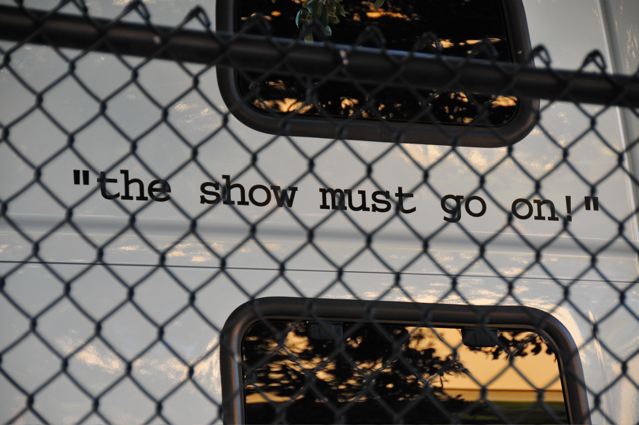
The truth is so clear How does it all stay organized?  The hierarchy goes like this:  everyone who works on the tour is responsible to their department head (i.e. management, sound, accounts, lighting, video, back line, wardrobe, catering, drivers).  The department heads are responsible to the production/tour manager (Dennis Sheehan).  Sheehan answers to the band.  Everyone builds their own little piece of the show, the puzzle is put together and the rehearsals ensure it runs like a well-oiled machine.  

The fans by now have had a few months to stew on the music and get their frenzy up for the upcoming tour.  Rehearsals are completed, the machine is fired up and the show goes on the road!

Let us know if there is any specific production aspect you are curious about and we’ll see what we can do about bringing you the story!