Following recent comments by U2 Promoter Arthur Fogel, all U2’s European tour dates have been announced. The band will not be playing gigs at Dublin’s O2 or Docklands as is being reported. All shows have been listed on U2TOURFANS.com
U2 Songs of Ascent Rumor Control
We posted a story a couple of days ago about Bono’s conversation with The Irish Idependent as well as The Edge’s comments with EW. Both have comfirmed that they have been working hard on the new album, thats not anything new.
Whats new was the the story that came out of the website “Undercover” The comments suggested a defined release date.
Now from a marketing and release point this may be cutting it a bit close since the tour resumes on June 6th - However non the less the story has been posted and the news of this has been pushed to a wide release.
Here are all the links to the story that have been pushed out so far. Lots of U2 fans sites have “New Album” sections. So don’t be too alarmed to see the same story over and over again. We will update you as soon as we have more information. Rumors are like bad hair days everyone has one and knows one.
U2 Intimacy
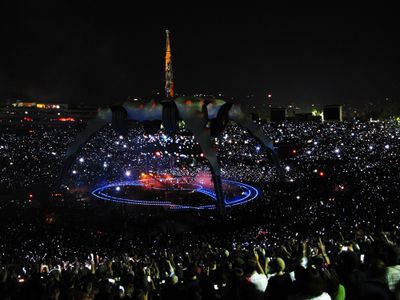
The inner ring nearest the main stage gives more than 3,000 fans close proximity to the band, while the outer ring gives the band access to standing and seated concertgoers farther out. At different times during the show, The Edge, Bono, Adam Clayton and even drummer Larry Mullins Jr. use two moving bridges to perform between the areas and are followed by video and audio all the way.
Of course, you’d expect the audio system used for such a massive setup to be huge — and it doesn’t disappoint. The setup comprises the latest in digital tech offered for live sound and, surprisingly, some tried-and-true analog gear.
The tour’s look and systems design was a collaboration between the band and audio director/front-of-house Joe O’Herlihy, show designer Willie Williams, production architect/designers Jeremy Lloyd and Mark Fisher, and Clair Global R&D and engineering teams.
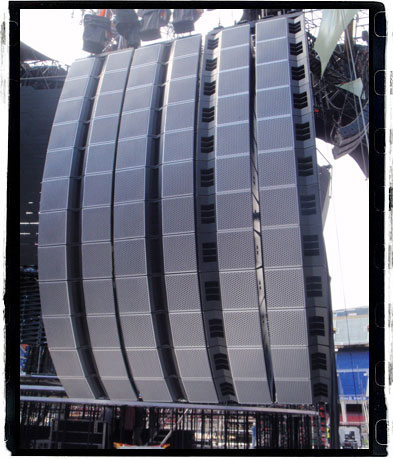
The speakers used are all Clair and comprise FOH left/right hangs of 36 i5 and 36 i5B; 24 i5 and 24 i5B rear; 16 i5 and 16 i5B at house left; and 16 i5 and 16 i5B at house right. Main stage front-fills include 24 FF2 and 24 BT218 subs, while the “B” stage area carries 72 S4 subs.
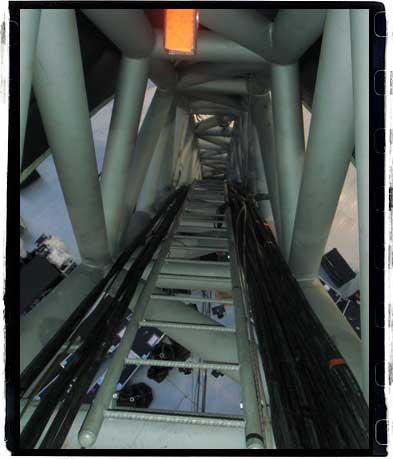
Consoles at FOH are redundant DiGiCo SD7s, each running identical shows. Jo Ravitch, senior systems engineer/Clair Global crew chief, says, “There are two main stage racks, one of them distributes AES to each leg and there’s a backup system of analog feeds to each amp, as well. If we have an issue with anything in this setup, I walk over here and switch to analog and Joe [O’Herlihy] walks over to the other board and picks up the mix.”
The front end for Bono and The Edge’s vocals and some of the compression for the guitars called for some unusual gear choices. Ravitch says, “When the tour started, there wasn’t very much [processing] available on the board so we’re using outboard stuff.” For Bono’s vocals, O’Herlihy calls on the Manley Vox Box; The Edge’s vocals take an Avalon 737. Compression for the guitars is on a Summit Audio DCL-200 comp/limiter, with the rest of the limiting provided by the SD7.
The system was a game-changer for O’Herlihy, who has been with U2 for more than 25 years. “The approach to the mix in the context of the way the sound is distributed has been enlightening, to be perfectly honest,” he says. “The size of the system has created an experience that is incredibly responsive. We now have something that’s almost touch-sensitive. When you make a move, there’s a large physical element of immediately hearing what you do.”
Because of the staging’s scope and design, the textbooks had to be thrown out and a system designed that would cover everyone. O’Herlihy says, “From the mix perspective, you have to get your head around the whole concept of having an inside column and an outside column, and how you distribute your gain structures accordingly.”
O’Herlihy has seen an exponential evolution in tour sound technology. He had his digital education on the DiGiCo D5, which was innovative at the time. On the Vertigo tour, he had the benefit of the D5 being around for a few years before he took it out. He did not have that luxury with the SD7, but trusted that it was the only console that could get the job done.
The SD7 was the only solution that let him put each and every individual channel where he wanted it without using external equipment that would have meant another link in the chain that could possibly fail. Still, the SD7 was a leap of faith and trust in DiGiCo. “We’ve had our glitches along the way with software updates, but like everything else, we’re in virgin territory here and we felt that that the SD7 is what made this whole thing work.”
Underneath It All
Monitor mixers Dave Skaff, Alistair McMillan and Niall Slevin make their home under the massive stage, which is also where offstage keyboardist Terry Lawless plays. Because all three mixers don’t have a view of the stage, they watch what’s going on via TV monitors at each station. And as the band is moving around so much, each station gets a four-camera split specially switched for their benefit, resulting in the band being visible at all times.
Using digital consoles has made it easier to provide specific mixes for each bandmember. The Edge has six guitar amps onstage and two under, while Clayton has five bass guitar feeds, and they rely on the team to provide the specific balances they need for each song.
Skaff points out the advantage: “Without digital, it would be a madness of markers and 3×5 index cards. At soundcheck, Bono will do half a song, shout out another song, do 12 bars of that song and shout out another. It would be impossible to get all that to come back without the digital consoles.”
Mixers Slevin and McMillan provide audio for The Edge and Bono on two DiGiCo SD7s, each running dual engines fed via MADI. Each desk runs both mixes, the thought being that if one console quits, the engineer can jump to the second engine on the working console and continue to work until the downed desk can be revived. The stage racks and local racks used for processing are also duplicated and can be quickly switched if needed. McMillan is recording the show to Steinberg Cubase on two independent Apple G5s, which top out at 90 tracks, 20 of which are ambience. “I feed [Bono] quite a bit of ambience,” says McMillan. “He enjoys hearing the audience reaction.”
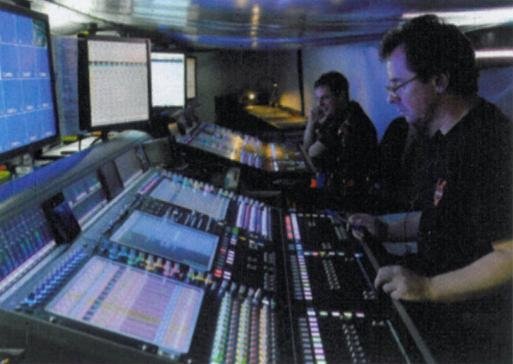
The rest of the band and effects are sent to a second channel on the Verona, which all go directly to Bono. For the singer’s reverb, he’s using the Bricasti M7, McMillan’s favorite new toy. “It’s more like glue than a reverb,” McMillan says. For Bono’s delays, he uses a TC Electronic 2290 and a variety of verbs from Lexicon and Yamaha across the rest of the band.
McMillan, who has mixed monitors for Van Morrison, came primarily from a studio background, having worked extensively at Windmill Lane in Dublin. “These guys have made me raise the bar within myself,” McMillan says. “After 20 years, you get set in your ways. Here, I had to start again and I love that.”
For The Edge, Niall Slevin runs 40 inputs per engine into his SD7, sharing the same rack feeds with McMillan. He uses an AMS reverb and a Lexicon PCM 80 for his mixes but duplicates his rack effects with onboard equivalents in case of failure. He also has duplicate analog processors in his rack for McMillan’s mixes should Alistair need to jump over to his console.
Slevin feels the SD7 is a big sonic improvement over the SD5, but he is realistic about its abilities. “It still has a few reliability issues, but we’re pushing it to the max, especially with the redundancy. Effectively, we’re throwing it out the top floor and seeing if it will fly. At the moment, it’s gliding, but it’s getting there. No one has had these consoles and pushed it as much as we have. When we find things out, DiGiCo has been very good about fixing it. I can’t imagine a situation at the moment in a rock ‘n’ roll theater or any other audio application that this couldn’t deal with.”
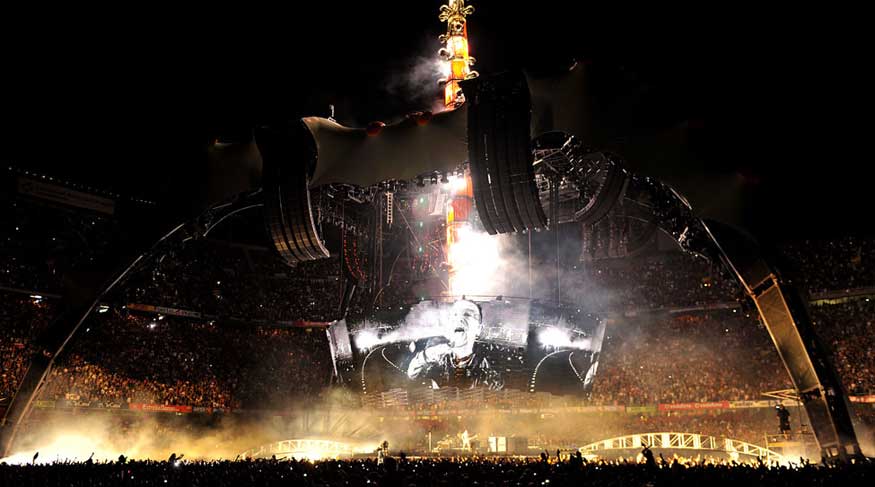
A show of this scale being launched during tough times is easy to pick on. But it’s hard to argue with its success both in record-breaking attendance and integration of new technology. At a time when album sales are not driving revenues, live performance has stepped into the spotlight and blazed a trail where other methods have failed. Did the band achieve “intimacy on a grand scale” as Bono proposed during the show? Only you can be the judge, but from my seat, it was dazzling.

360 Underworld View
Monitor duties are split up among the engineers, with Slevin providing mixes for guitarist the Edge, McMillan doing the same for singer Bono, and Skaff tackling sound for drummer Larry Mullen Jr., bassist Adam Clayton and offstage keyboardist Terry Lawless.
All the band members are wearing Future Sonics ear buds attached to Sennheiser G2 wireless systems, but below the deck, the gear uniformity ends. Slevin and McMillan both mix on DiGiCo SD7 desks, while Skaff is positioned behind a Digidesign D-Show
Profile. All of the engineers mix watching the show via video screens, keeping an eye on their respective charges for visual cues.
Since the SD7 still a relatively new desk, the tour marked the first time McMillan, a seasoned FOH and studio engineer, had used one: “I wasn’t sure of this at first and I’m still acclimating to the change, but I was pleasantly surprised,” he said. “It sounds good, that’s the main thing.”
Oddly enough, though, it works in concert with a second console. On the 2005-06 Vertigo tour, Bono found he was thrown off by the processing delay of the digital console used at that time.
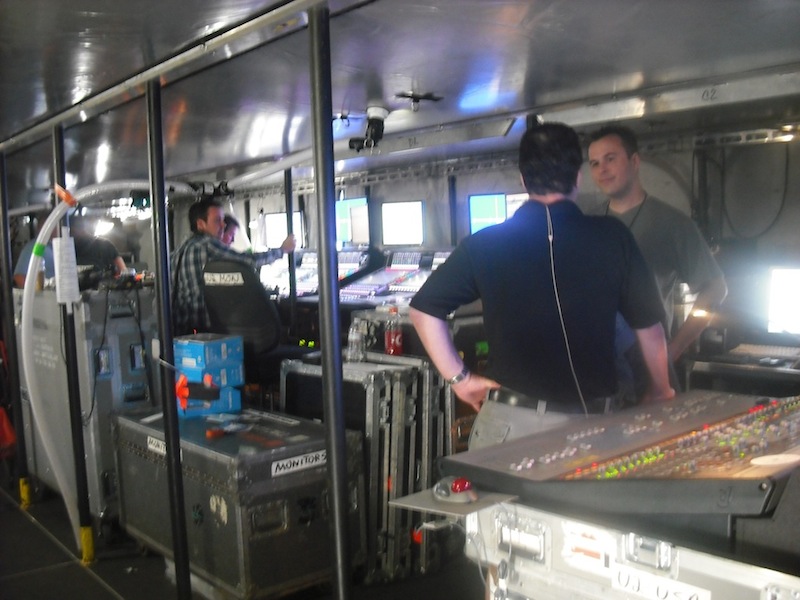
Over at the Digidesign Profile, Skaff keeps things rolling for the rhythm section, much as he as since joining the band’s live crew in 1985 (“I don’t count when I drove gear in ‘83”). In between the previous U2 world tour and this one, Skaff worked for Digidesign, but first began using a Profile on the Vertigo jaunt, noting, “When it finally came around that I had to make a switch, I really liked the platform, the sound of it.”
With that kind of background, it’s no surprise that he’s comfortable working with the multitude of plug-ins available for the desk: “For experimenting, it is really great because it’s like having a giant rack of gear available to you all the time. I use an awful lot of the McDSP stuff, Crane Song’s Phoenix and a lot of the Waves plug-ins as well. Phoenix is one of those one-knob, ‘I can’t believe what it does’ things. It’s just one knob that makes it better; whatever you put it on, it just brings it right out of the mix into whatever you’re listening to. Rob Scovill turned me on to it.”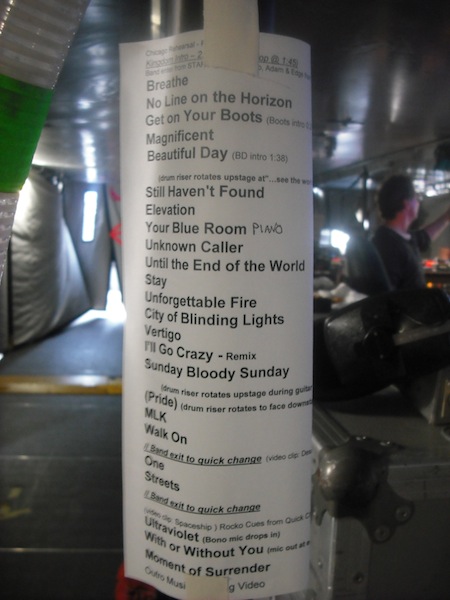
As Skaff’s tenure might indicate, much of U2’s audio staff have been with the band for years, but this tour is marks McMillan’s first time on the road with the group. Mixing for one of rock’s more unpredictable frontmen might seem daunting, but the engineer has found that a studio-quality mix isn’t always the right fit for Bono: “He’s all about energy, so it’s probably not that ‘Hi-Fi.’ It’s not a nice-sounding mix; generally ‘nice-sounding’ doesn’t work for him. It’s not necessarily loud for the sake of it, but finding the energy, that’s what he gets off on. There’s a lot of effects on his vocal, a lot of reverb, probably more than a record mix, but you know, it works for him. And I use an awful lot of ambience as well—I haven’t discussed it with him, but I’ve just discovered that over a little while. The more audience reaction I can put in, the more he likes it!”
U2, Sinead O'Connor, Chieftains
“Music of Ireland” will be available as a CD and DVD in a number of outlets: Barnes & Noble is the exclusive retail partner and will debut an in-store promotional campaign on March 2; Amazon.com will feature all the CD tracks digitally on a 45-day exclusive starting that same day. In addition, the CD and DVD will be bundled as a bonus for those who donate to public television during pledge drives.
The CD was produced by John Reynolds, and features new material by Clannad’s Moya Brennan - who also hosts the documentary - O’Connor, the Chieftans, former Irish Tenor Ronan Tynan and Shane MacGowan of the Pogues, among others.
The documentary “Music of Ireland” opens in 1960 with the success of the pioneering Clancy Brothers, and includes Liam Clancy’s final U.S. television interview before his death. Other interviews include “Riverdance’s” Michael Flatley, Bob Geldof and Academy Award-nominated director Jim Sheridan.
A sequel to the “Music of Ireland” is planned for later this year, and will focus on U2, Celtic Woman, The Cranberries, The Corrs, the Irish Tenors and songwriters Glen Hansard and Damien Rice.
“For such a small country to produce such amazing talent and the way their music defines the people is just extraordinary,” Young told Billboard magazine . “It has fascinated me for most of my life and is something I wanted more people to be in tune with.”
New U2 Album Expected In June
Word is that Bono has said the next U2 album (Songs of Ascent) should be released in June, timely since the tour happens to be starting. During Bono’s interview with Sean O’Hagan he said the sister album to NLOTH would be called “Songs of Ascent” consider it to be a book end kind of like Zooropa and Achtung Baby.
We expect to see producers Brian Eno and Daniel Lanois once again as well as Steve Lillywhite this power house combination has seem to work well for the boys.
Some of the songs are expected to be the leftover tracks from ‘No Line On The Horizon’, but some are older. Songs expected to be used include ‘North Star’, an unused track from ‘How To Dismantle An Atomic Bomb’. ‘Winter’, the song that didn’t make ‘No Line On The Horizon’ but was used in the movie ‘Brothers’ is expected to make the new album and ‘Kingdom Of Your Love’, heard in part of the intro music of the U2 360 Tour is also expected on the album.
Other tracks we might find there are “Every Breaking Wave’, ‘If I Could Live My Life Again’, ‘Love Is All We Have Left’, ‘Mercy’, ‘Lead Me In The Way I Should Go’ and ‘You Can’t Give Away Your Heart’.
Bono told the Irish Independent that the album may be out in June. ( Note the key word MAY)
U2TOURFANS 2 GO
Building on the success of the new iPhone and iTouch Application the team has been hard at work creating version 2 of the popular U2TOURFANS app. In order to improve te team has choosen to reach out to the fans for major feedback on improvement features. - We want to hear from you ! Drop us note in the feedback section.
U2 Fan Experience
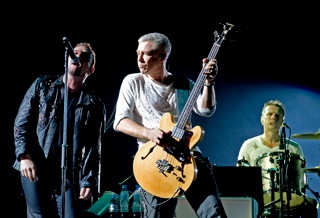
What was yours ? How did the show move you ? What was your experience?
Of course we have tons of videos and photos and intereviews, what about your story ? Lets reach back in time and enjoy this fans experience.
U2 is an experience. And I know that sounds kitsch and over the top if you don’t like them, and have never been to one of their shows.
I’ve heard that said over and over again, and I thought I understood it. I’ve got the dvd’s of previous tours, and watch them a fair amount.
But when I got there, and stood in front of Edge’s amps as he drove out perfect note after perfect note on ‘Breathe’, taking a rather normal base chord structure to levels you wouldn’t think it could go to, and as Bono quite literally sang his heart out, and 97,000 people for just 2 hours got to drop their learned inhibitions and allow songs to take them somewhere they might not otherwise be able to go……as over the top as it might sound, it is a spiritual experience.
So as much as I joke about the night not being fulfilled until security escorts me out for trying too hard to touch Edge, Bono, Larry, Adam, or even one of the stage crew, once you get there, it’s just about letting yourself go.
Now, U2 is not for everybody. They’re obviously for a lot of people, but not for everybody. But I can pretty much guarantee you that if you were to go to a live show of theirs, and leave any preconceived notions at the door, you would at the very least feel something.
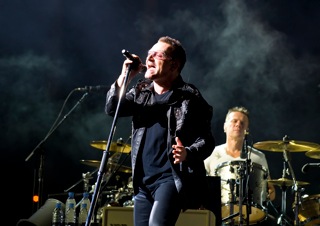
To be able to be crushed by 2490 fans in the inner circle jumping to ‘No Line on the Horizon’ as I in turn crush the 10 in front of me. To sing ‘No more!’ until you think you’re going to collapse, but it’s okay because thousands of other people from 5 years old to 65 years old are singing the same thing with the same intensity around you.
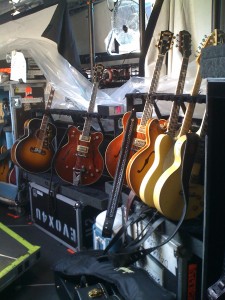
And of course, to almost be able to touch Edge’s guitar when he leaned over the rail. And above absolutely everything else, to hear the untouched and pre-mic’d tone directly from his amps. Not to sound overly sentimental
U2:Cedars Of Lebanon
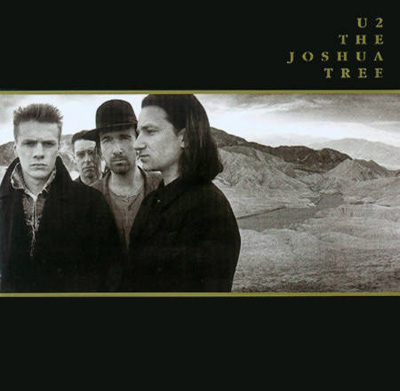
Some have pointed out that the underpinning track might be a straight lift from Eno’s ambient album The Pearl, a collaboration with Harold Budd back in 1984. Whatever, the history of the music, the lyric leaves us with a few questions.
The last song on a U2 album is always carefully chosen. Track listings are never carelessly thrown together. So, what was the reason for this track closing out NLOTH? Cedars Of Lebanon takes us into the Bible.
There is no way that Bono’s use of the phrase is coincidental. Their time at Fez during the Sacred Musical Festival might not have seen them use sufi prayers or chants but it certainly gave them the inspiration and courage to make a seriously spiritual record. Cedars of Lebanon are used in various ways in the Scriptures. However, what does Bono mean by its use here. A quick glance across Wikipedia and you find a plethora of Biblical uses for the Cedars Of Lebanon;
“Jewish priests were ordered by Moses to use the bark of the Lebanon Cedar in circumcision and treatment of leprosy. Isaiah used the Lebanon Cedar as a metaphor for the pride of the world. According to the Talmud, Jews once burned Lebanese cedar wood on the Mount of Olives to announce the new year. Kings far and near requested the wood for religious and civil constructs, the most famous of which are King Solomon’s Temple in Jerusalem and David’s and Solomon’s Palaces.”
Bono might be simply talking about the size of the Cedars and how God is bigger but where can he be found? The journalist might be journaling his objective feelings of the war zone and asking where God is or he might be seeking a more subjective interaction with God in his own life’s fraying threads.
Or Bono might be asking if God can be found in his Church, that the Old Testament tells us Cedars were used to build? Or is it Isaiah’s use as a symbol of pride that he is highlighting? Where is God in the deluded egos that go to war or in the self indulgent personal ego of a man wrestling with home and all that that means?
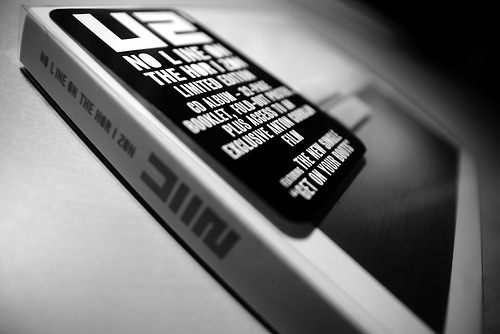
We didn’t choose the obvious enemies - The Man, the establishment. We didn’t buy into that. Our credo was: no them, there’s only us.” In a song about war Bono then turns inside for the enemy, “”What that means is that we picked enemies that were more internal - our own hypocrisy…They are nearly always of a psychological, if not a spiritual, nature. The spectres that hold you back, they were our enemies.”
Back in the context of the third person war journalist song had the journalist mistakenly and fatally made home and God his enemies?
Or is Bono remembering his old mate George W? He chose his enemies post 9/11 and his entire legacy will be based around that choice. Even now, when his friends are all gone to other arts and parts and he is on his ranch in Texas, all alone, that relationship which Bush had with his enemies defines him in the recent annals of history. If we glance back at the video For The Saints Are Coming we see the alternative enemy that Bush’s administration could have fought, the natural disaster effecting their very own people on the Gulf Coast. How different would the definition of Bush have been had he chosen the right enemy?
We guess if we stop to become aware of the battles that we fight without even thinking we could then spend some spiritual wisdom prioritising what needs fought and what doesn’t. The personal or national pride that Isaiah named as humanity’s Cedars of Lebanon might be a good place to start.