- Hotline: 1-888-407-4747
- To Donate $10: Text ‘Haiti’ to 90999
- U.S. State Department
- American Red Cross
- Mercy Corps
- CARE
- Oxfam
- Doctors without Borders
- UNICEF
- Agape Flights - 941-488-0990
U2, Americal Idol, and Elevation DVD
Tour season is right around the corner and if you’re a fan you about jumping off the roof right about now. The band has been just kicking back, no major announcements. Of course lots of interesting rumors, should we pass them along? Well the only one worth throwing out is could it be possible that U2 allows the “artists” from American Idol to use their songs again? We asked the question last night on our Facebook fan page and course your welcome to throw up your comments too. Most say “Hell No”
After watching a couple of minutes of AI we choose to dig into our DVD collection and attend a virtual concert.
U2 - Elevation Tour 2001: Live from Boston
After the huge, lavish spectacles of previous tours, U2 decided to tone things down a bit for Elevation, which accompanied their All That You Can’t Leave Behind album. Just as the album marked a return to a simpler more stripped-down sound, the live shows returned to smaller venues and a more intimate show, and from start to finish Elevation provides a welcome reminder of what a great band this is. Recorded in Boston, the show features a healthy mix of new and old songs, which were written over the course of two decades but sound as fresh and relevant as ever. From classics like “Sunday Bloody Sunday,” “Where the Streets Have No Name,” and “I Will Follow” right up to instant favorites such as “Beautiful Day” and “Elevation,” every track is stunningly executed. If you saw the concerts, this is a worthy and lasting souvenir; if you didn’t, watch this and you might be kicking yourself.
The disc does a great job of showing how straightforward the tour was. It was a big tour with a huge crew, but on stage the four musicians were pretty much on their own. The camera catches a few great close-ups of the members of the band in which you can really see their facial expressions. The Edge seemed quite preoccupied with playing the music. Larry Mullen and Adam Clayton seemed to be genuinely enjoying themselves. Bono played the rock star. There are a few great shots where you see The Edge looking to Larry Mullen for the rhythm. For a second they seem less like U2, and more like four guys in a band.
The setlist included songs from All That You Can’t Leave Behind, a few of the U2 classics, and a few refreshing unlikely choices (Gone, Bad, Stay (Faraway, so close), Until The End Of The World). The Edge used the set list as an opportunity to parade an amazing set of classic guitars including a full-bodied Gretsch, a pearl Telecaster, Edge’s classic Gibson Explorer, a Godin, a beautiful clear woodgrain finish Stratocaster, and a 12-string Richenbacher that The Edge kicks off the stage.
What we found most striking about the DVD was how great U2 is at putting on a rock concert. You can really see the experience of 20 years of touring. Bono plays the 20,000 strong audience like it was a percussive instrument. The Edge’s guitar and Bono’s voice alone can fill a stadium design for NHL hockey.
The album contrasts nicely with the material in the context of the concert. If Stuck in a Moment were a little more immature and unrefined, if would fit in perfectly on Rattle and Hum.
The live performances shed new light on some of what we had though where the weaker songs from All That You Can’t Leave Behind. New York, which always struck us as goofy (comparing the heat of New York to a “hair dryer in your face” just doesn’t hold up next to the biblical alegory of The End of the World- which Bono introduces this night with “this is judas”) and Walk On both shine make more sense in the live context.
Highlights include, the inclusion of Until The End Of The World and a great rendition of Stay (Faraway, so close). Introducing the band, Bono says “Even his mother calls him, The Edge”. The introductions to The Fly and Where the Streets Have No Nameare classic goosebump-inducing stadium rock moments.
Well how many more months away are we from the start ? 4 Months -
The Edge says he hates jamming
 U2 guitarist the Edge is not a big fan of jamming. “I try and avoid it at all costs. Jamming is really the most awful, excruciating experience for me, I really don’t enjoy it,” he says.
“First of all, that’s not how I work as a guitar player. I compose using the instrument, I don’t really sit down and play for the sake of playing stuff.
“So the idea of jamming - endless, directionless noodling around some nondescript chord progression - I really find very boring.”
The Edge was in Dublin last week for the launch of the movie, “It Might Get Loud,” which focuses on guitarists Jimmy Page, The Edge and Jack White.
The Dublin launch was a rare respite from the monster 360 Tour which earned a whopping $123 million in the U.S. for the band, who sold more than 1.3 million tickets along the way
'Spider-Man' turns on the lights

The show, the most expensive in Broadway history, was supposed to open in March at the Hilton Theater. It ran aground when David Garfinkle, its inexperienced and inept lead producer, failed to come with the money.Bono’s longtime business partner, Michael Cohl, stepped in to clean up the mess.
The financing is now in place, with a chunk coming from Disney, which recently acquired Marvel Comics. The show will likely begin previews in September and open in November, sources have said Refunds are now available for people who bought tickets for performances this spring — previews were supposed to have begun next month — and do not want to exchange them for new dates in the fall. “Cohl and Disney have sorted it all out,” one source said. “Garfinkle is around in name only.” Julie Taymor, who directed “The Lion King,” is staging “Spider-Man.” Alan Cumming is still on board as the Green Goblin. Spider-Man will be played by newcomer Reeve Carney.
Under the Big Top
Happy New Year, and please welcome our guest writer Nikki back -
Blackstone, MA
 Crew Pass - ( Working Crew)U2’s convictions about live performance began even before the roots of their calling took hold. When teenagers form a band, they are most concerned with such details as learning their craft (U2 knew all of three chords and Adam barely knew how to pedal a bass), getting gigs, and making enough money to score a decent meal. For U2, it started with lighting. The lighting had to be just right. They obsessed with the lighting! The visual aesthetic was nothing short of critical. The most recognizable show from their past, before The Joshua Tree tour, was the stage awakening that was the War Tour. Red floors, white flags, stage climbing, camouflage draped over stage equipment; they were a band making a statement. You see, it’s what they’ve always done. Statements about politics, religion, pop culture. It should be no surprise to any hardcore fan that the shows evolved into what they are today. The band’s fundamental philosophy was that the show had to be magnetic, keep everyone’s attention, and accessible to everyone.
Since the late 70’s when the boys were cutting their teeth on the local circuit, U2 always sought intimacy with their audience. The band performed at venues such as Dandelion Market in Dublin, Mount Temple, Trinity College, churches, youth clubs, and community centers mainly to provide access to the younger fans who essentially couldn’t get into the licensed pubs because they were simply too young.
 U2 was born during a time when punk was on fire and rock bands were redefining the live rock show. In the late 60’s, Pink Floyd paved the way for the epic visual rock show followed by celebrated bands and artists such as Genesis, The Velvet Underground, and David Bowie. Bono’s MacPhisto, Mirror Ball Man and the Boxer characters are reminiscent of Peter Gabriel’s Green Man or David Bowie’s Ziggy Stardust or Thin White Duke. While U2 was yet to venture into such elaborate performances, these were some of the influences that tilled the soil that would soon cultivate the seeds of the operation we see today with their most technologically ambitious 360 Tour.
The minimalist stage sets of the Boy, Gloria, and War tours became increasingly difficult as the popularity of the band grew when The Unforgettable Fire was released and the tour had to be planned. The size of the venues were increasing and it became progressively difficult to keep the spectacle low-key.
At this time, Bono’s stage clothes consisted of a black knit mesh shirt, black and white checkered or black leather pants, and the mod black leather boots you could find anywhere in Europe at that time. Ironically enough, Adam, who has always been known as the most posh of the band even from the moment he answered Larry Mullen Jr.’s ad for a bass player at Mount Temple, often looked like any other kid cruising the streets back then. Except for the striking bush of blonde curls! The Edge and Larry dressed just like any other teenager you could find in Dublin. Today, they are very well put-together.
With War, things started to get more refined. There was also a lot of stage climbing by Bono. While the Unforgettable Fire proved more of a challenge for the stage design they had loved and proven successful, they still managed to create a very specific mood and atmosphere with large backdrops and monochromatic banners hanging above the stage. With the explosion of The Joshua Tree, U2 was catapulted into superstardom and with that success, were provided the financial leverage to start exploring new presentations for the stage.
Williams has worked with many of the heavy hitters in rock such as R.E.M., David Bowie, and The Rolling Stones. He states that “U2 is unique among their peers in respect of their approach to performing.” They are included in the design process from the time the very first thread of an idea is casually raised until the end of the tour. Just like they’ve always done from the very beginning.
Williams’ job is to bring art to the stage and between tours, he gathers ideas. He just doesn’t worry about the art of the show but what kind of show it might be. He knows that fans don’t necessarily want U2 to change, but they also don’t want them to repeat themselves, and that’s a tremendous challenge. About a year out from the first scheduled date of the tour (which in my opinion is a relatively short time to pull something together as massive as Zoo TV, Pop Mart, or 360!), Williams and the band come together like old school chums and begin churning ideas. One of the most challenging pieces is figuring what technology is available, or on the cusp of availability by the time the show hits the road. There’s a rule the design unit follows: to conform to three concepts until there is that one idea that continues to interest and excite them. Thus, the production is born.
While the designs are being discussed, ideas are funneled down to the band’s production manager, Dennis Sheehan (with the band since 1982), who is simultaneously covering details such as seeking bids from fabrication companies as soon as the design is settled, making sure the budget is on track with the accountants, and leading discussions with the entire tour team so that they get the idea and feel of the show and get proactive about any potential problems, in order to get in front of the 8-ball a bit.
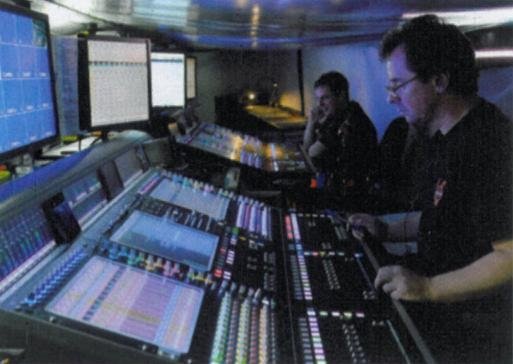
Production rehearsals get underway and the crew spends two to four weeks constructing the show. When shows are as complex as Zoo TV/Pop Mart/360, it’s critical to practice the set-up so that the crew can become as efficient as possible and iron out any difficulties or issues with the process. This saves time. Time is money. With the cost of the current tour at $750,000, it’s an important factor.
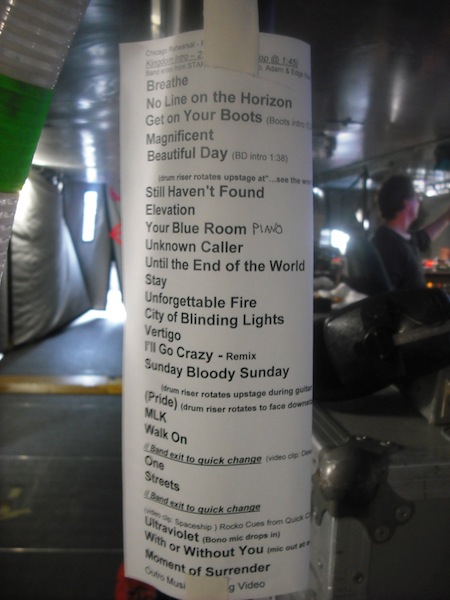
Finally, the band arrives at production rehearsals. Set list at this point is Williams’ primary target. While they all make agreements on how the show will open, what the middle will look and sound like, and how the show will end, the rest is open for some breathing room. About one third of the set will be songs from the new album and they go to work making sense out of their history and decide which songs from their catalog can play into the context of the show. The set list itself is a work of art.
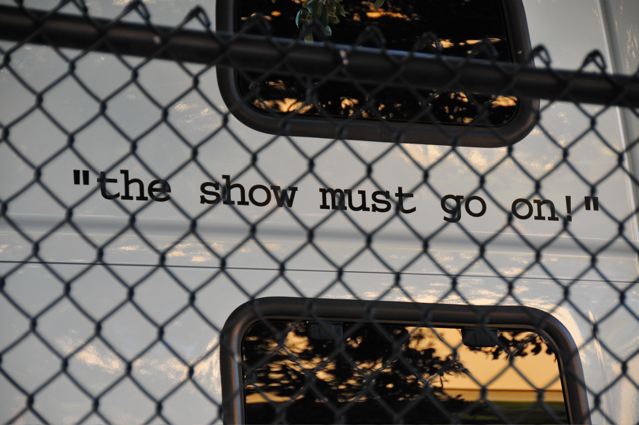
The fans by now have had a few months to stew on the music and get their frenzy up for the upcoming tour. Rehearsals are completed, the machine is fired up and the show goes on the road!
Let us know if there is any specific production aspect you are curious about and we’ll see what we can do about bringing you the story!
The Gospel According to U2
We Get to Carry Each Other: The Gospel according to U2 (Gospel According to U2)

The title of Greg Garrett’s book about the spiritual side of Bono and U2 proclaims his central argument from the front cover. The book is called We Get to Carry Each Other: The Gospel According to U2.
Do you know those famous words?
Rolling Stone ranks “One” (the song in which this line appears) as No. 36 among the 500 Greatest Songs of All Time. It was released way back in the early 1990s, when the band was at a crossroads and nearly broke up. Depending on your age, you might recall the more recent Mary J. Blige version of the song, which also was a hit.
The words that end the song — which prompt men and women around the world to “sing along” — are:
One love, one blood, one life. You got to do what you should. One life with each other: sisters, brothers. One life, but we’re not the same. We get to carry each other. Carry each other. One, one.
And, in singing along, we’re essentially joining in a global hymn, Greg argues. He writes, “The meaning of life, U2 ultimately reminds us, is not in how much gold you pile up, how many mansions you build, how many people you can order around, or even how loudly and devoutly you pray and proclaim your salvation. It is in what we get to do for each other. “This is U2’s faithful message to the world.” Did you catch that key phrase, “get to,” in the lyrics and in Greg’s book? That phrase means that it’s one of life’s great privileges that we get to help each other. Wow! That’s a sermon that’ll snap your head around, if you stop to listen to the lyrics!
Our spiritual mission doesn’t lie in graciously deciding that we’ll donate a little bit of money or expend a little effort on behalf of the needy — when it’s convenient for us. No. The orientation here is waking up in the morning and feeling thankful that we get to help out wherever we can.
CONVERSATION WITH GREG GARRETT ON U2:
DAVID: We’ve told readers about your work before, Greg — especially your earlier book on the spiritual lessons of comic book super heroes. You’re always drawing creative connections between spirituality and popular culture. Tell us what you do for a living - beyond writing books.
GREG: I am professor of English at Baylor University and I’m writer in residence at the Episcopal Seminary of the Southwest in Austin and I’m a licensed lay preacher in the Episcopal Church. Mostly, I’m known as a writer and a teacher.
DAVID: We should explain to readers that, in addition to attending U2 concerts and following the band’s work over the years — you once had an opportunity to sit down with these guys and interview them.
GREG: I did. It was back in the days when I was a rock journalist. I interviewed them after they had recorded their second album.
DAVID: These guys are not card-carrying members of any particular religious group, are they? They’re not regularly practicing Catholics, for example.
GREG: No, they absolutely are not. The interesting thing for many of your readers is that they have been people of faith — but outside of almost any organized religious tradition for more than 30 years. They grew up in Ireland and saw the people of Ireland blowing each other up over divisions of faith. They’ve felt they could live out their lives of faith more authentically outside of any organized tradition. Three of the four members would think of themselves as Christian but they have not been part of a formal Christian organization for more than 30 years. They seem to be very much in tune with various faith and wisdom traditions, though. They have worked with the Dalai Lama and with Jewish leaders and many others — so it’s a very ecumenical understanding they have about how we are called to be the face of change for the world.
We Get to Carry Each Other: The Gospel according to U2 (Gospel According to U2)
DAVID: In a way, they’re a voice for the “Nones” — the growing ranks of Americans who answer with the word, “None,” when pollsters ask them for their “religious affiliation.”
GREG: Yes, Brian McLaren talks about them in this way. In a very real sense, they model new ways of being a faith community. The have a very clear sense of mission — we are called together to help people. And, as they work out this mission, they seem to be modeling a new way to be people of faith.
DAVID: Why are they so enduring in their popularity?
GREG: Not only are they a band with incredible longevity, so they have lots of sales and awards and fans who follow them, but they’re also a band that continually reinvents itself and keeps itself relevant. The new album, No Line on the Horizon, has new sounds and ideas. I don’t want to criticize other bands by name, but people know which bands only go back to work when they need more money. U2 was freed from that necessity very early in their career because of some smart business decisions they made. They’re free from having to worry about making more money. So, in an album like No Line on the Horizon, there are elements of their past albums — but you also hear some new Eastern stuff that comes from recording in Morocco. It’s recognizable as U2, but they’re still exploring new music. They’re not resting on their laurels.
DAVID: They started out with some concerns very close to home, but they’ve become world citizens. That’s a pretty surprising transition for four guys from Dublin.
We Get to Carry Each Other: The Gospel according to U2 (Gospel According to U2)
GREG: The four did grow up in Dublin. Ireland was what they knew. But they soon had some powerful experiences of the world. Particularly, Bono traveled to Central America and Africa. In Ethiopia, he had a father hand him a starving child and tell him: “Take him home with you, please. If he stays here, he will die.” That’s powerful stuff. Their consciousness expanded so greatly that they came to see the whole world needs help — not just the people in Ireland.
DAVID: Is this spiritual mission we’re talking an effort by the entire U2 band? Or is this really Bono we’re talking about in terms of these spiritual commitments?
GREG: That’s a cool question and difficult to answer. From years of following U2 and from my research for this new book, I would say: Bono is the point person, but he is representing the band in concerns they share. When we look at the benefit concerts they do — or the benefit tour they did for Amnesty International — you can see this is a thrust they’re making together. It’s like they’re part of a family and they make these efforts together. Here in America recently, the guitar player The Edge partnered with Gibson guitars to help get instruments back into the hands of musicians along the Gulf Coast who lost their instruments in the big hurricane. So, the whole band obviously cares about these issues.
DAVID: With so much music released over the years, what albums would you suggest that newcomers pick up to familiarize themselves with U2?
GREG: The obvious and perhaps the easiest answer is to get one of the Best Of albums. If you listen to some of the music from early to mid career, a lot of people will say: “Ohhh, that song is by U2?” Another good first choice is All That You Can’t Leave Behind. This is the album that came out in October of 2001.
DAVID: Rolling Stone called it the band’s “third masterpiece.” Joshua Tree and Achtung Baby were the first two in Rolling Stone’s list.
GREG: This is the album associated with many of the things we were dealing with after 9/11. Then, early the following year, they performed at the Super Bowl. So that album is a good choice. But I also recommend the new album, No Line on the Horizon, because it’s as intentionally spiritual as anything they’ve ever written.
DAVID: In Part 1 of this U2 story, we shared some of the words from a song on that new album, “Cedars of Lebanon.” The song warns people to “choose your enemies carefully, ‘cause they will define you.”
We Get to Carry Each Other: The Gospel according to U2 (Gospel According to U2)
GREG: Yes, they’re warning that we can be defined by our hatred. The album has allusions to the Middle East adventures of Great Britain and America. U2 has been standing up against practices like torture and rendition that are just now coming to light more fully. In a very real sense, they’re saying that your enemies will define you. You’ve got to be cautious about how you combat evil — because it can make you evil yourself.
DAVID: They seem to be stepping into the classic tradition of the ancient Hebrew prophets — these courageous figures who stood up to powerful figures and called for justice and a return to basic religious values.
GREG: One of the sections of my book deals with the tradition of prophetic voices and I take a look at the idea of “prophetic” as not referring to “predicting the future,” which is a definition a lot of people know from popular culture, but “prophetic voice” as a phrase really describing someone who speaks truth to power. For Bono and U2, this isn’t about religious propositions or orthodoxy — it’s about deep spiritual truths like standing in solidarity with the poor. Bono describes what he is doing now as serving as a lobbyist for the poor.
DAVID: You’ve traveled widely, Greg. You’ve heard many of the world’s great preachers — yet your book explains that you’ve been profoundly moved, over many years, by the spiritual messages preached by this rock band.
GREG: I wrote this book because I do have a profound personal connection with the band. And it’s not just that I sat down with them for an interview 27 years ago. It’s because their music and their lives have shown up in my life over and over again. All the work I have done in writing and teaching about religion and culture has grown out of this kind of experience. U2 is one way that many people feel God moving in their lives. For so many people, they don’t feel it in organized religion but in experiences like turning on the radio and hearing a song they desperately needed to hear at that moment. I have a passion for this particular book and this group — because these musicians have set out on an authentic spiritual quest and have told the world about it honestly. They are reaching out to millions through their music — letting us know we are not alone in our journeys.
This article was originally published at Read The Spirit.
We Get to Carry Each Other: The Gospel according to U2 (Gospel According to U2)
U2's Bono proposes
U2’s Bono proposes ‘Festival of Abraham’ in Jerusalem
U2 lead singer Bono has suggested holding an arts festival that celebrates the origin of the three Abrahamic religions: Judaism, Christianity and Islam. In an op-ed published by the New York Times, the rocker, who is also the founder of the advocacy group ONE and (Product) RED, said the festival is “something that could never have happened in the Naughts but will maybe be possible in the Tweens or Teens — if there’s a breakthrough in the Mideast peace process.” In the editorial, which lists “10 ideas that might make the next 10 years more interesting,” the Irish singer said the proposed festival could be held in a different location every year.”Jerusalem would obviously be the best place to start,” he wrote. “In Ireland, at the height of the ‘Troubles,’ it was said that the only solution for rabid sectarianism was to let 1,000 punk-rock bands bloom: music helped create a free space for dialogue (of a high-volume variety). So no politicians allowed. Artists only,” said Bono.
Bono and Edge brave weather
 Bono and The Edge enjoyed a rare boys’ night out in Dublin - but were late because of the bad weather.
The U2 pair attended a special preview charity screening of Davis Guggenheim’s film It Might Get Loud at Temple Bar’s Irish Film Institute last night. The stars joined long- time friends, singer Gavin Friday and U2 manager Paul McGuinness, among others, to mark the involvement in the production of U2’s very own sculptor in sound, The Edge. To celebrate his achievement dad-of-five David Evans, better known as The Edge, took to the stage before the screening to officially open the film. Wearing his trademark black hat, the legendary musician paid a special tribute to his bandmates and friends of over 30 years.
“Obviously without Bono, Adam and Larry I couldn’t have done it at all so in their own way they are the wind beneath my wings,” he said. “It was great being involved and I was very proud to be invited to take part, I think it turned out very well. It’s great to be back in Dublin and I really appreciate so many people coming out in the bad weather to support me.”
The film examines the interplay between three talented guitarists; modern traditionalist Jack White of The White Stripes, Led Zeppelin’s legendary Jimmy Page and, of course, our very own The Edge. The director of An Inconvenient Truth, Guggenheim’s aim was to show the three diverse artists’ attitudes towards music and their philosophies through various group and individual interviews and footage of the trio. But, according to The Edge, the three were more alike than he had first suspected, explaining that he had forged a close bond with his co-stars during filming. Speaking about White, The Edge described him as “a great showman”, revealing that the star had worn six-inch platform heels throughout filming.
He also joked with manager Paul McGuinness — who was seated in the audience — that he had yet to be paid for the charity venture, laughing that “we’ll have to discuss that later”. The star paid special tribute to his children during his speech, including model daughter Holly Evans, who was seated next to Bono. Showing his lighter side, the singer, wearing his signature dark glasses, gave his friend’s daughter a thumbs up. The Edge also gave some teachers from his former secondary school, Mount Temple Comprehensive School a special mention. “They were the leading force in getting the band going in the first place,” he told the packed cinema theatre. His words were met with rapturous applause as he left the stage to take his seat between Bono and Holly to watch the film. Other big names who stepped out to attend the special screening in aid of Our Lady’s Children’s Hospital, Crumlin, included artist Guggi and designer John Rocha.